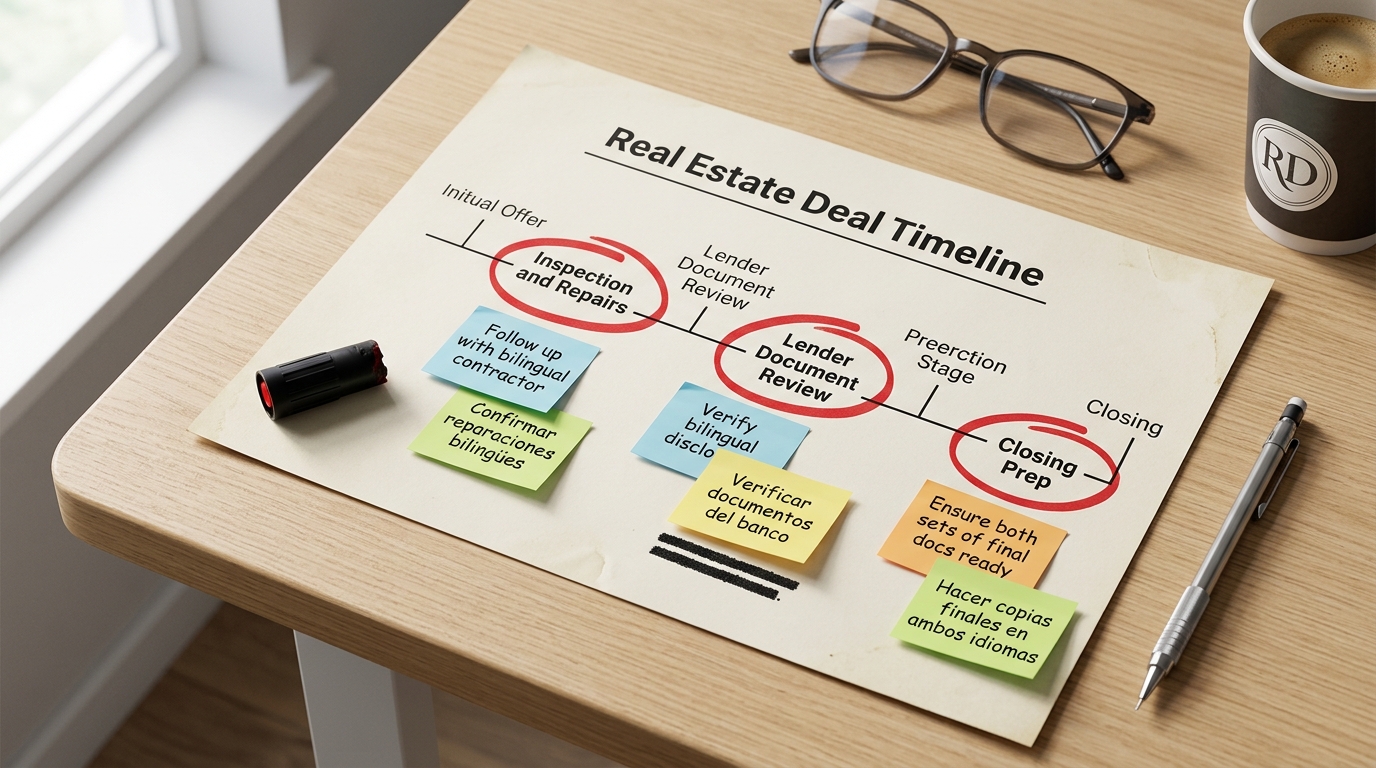
The invisible translator tax bilingual agents pay on every deal
Before we get into the timeline, we need to name something that never appears on any closing checklist: the invisible translator tax. This is the cumulative, untracked time a bilingual agent spends verbally re-explaining English-only documents to Spanish-speaking clients — lender disclosures, inspection reports, title commitments, the Closing Disclosure itself.
In English-only deals, a buyer reads a document, signs it, and moves on. In a bilingual deal, the agent reads the document, translates the meaning (not just the words) into Spanish over the phone or at the kitchen table, answers follow-up questions that surface because the client couldn't read the original, and then circles back to confirm the client is comfortable signing. That sequence happens at every document-heavy stage.
The translator tax isn't a one-time cost. It compounds at every stage of the deal — intake, inspection, lender coordination, title, and closing — adding hours that never show up on any timesheet but always show up on the calendar.
We've written before about how bilingual real estate work is an operations problem, not a translation problem. This post makes that argument concrete by showing you exactly where in the deal timeline the tax hits hardest — and how many days each friction point costs.
Stage 1: Intake and contract — the comprehension gap starts here
The deal hasn't even started and the language gap is already creating drag. In Florida, contracts must be executed in English — that's state law. Florida Realtors released Spanish-language translations of the FAR/BAR and AS IS contracts in April 2026, but these are explicitly non-binding reference tools. The legal document your Spanish-speaking buyer signs is still in English.
Here's what that looks like in practice: you sit with your buyer, walk them through the AS IS FAR/BAR contract in Spanish, they nod along, and they sign the English version. Two days later, they call you. They have questions about the inspection contingency timeline. Or they didn't realize the earnest money deposit was due within three days. Or they thought 'AS IS' meant the seller would still fix the roof.
This is the first named friction point: contract comprehension lag. The buyer signs on Day 1 but doesn't fully understand the terms until Day 3 or 4, after they've had time to re-read the Spanish reference or talk to a family member. By then, deposit deadlines may have already passed or the inspection window has shrunk.
| Touchpoint | English-only deal | Bilingual deal (typical) |
|---|---|---|
| Contract review | Buyer reads, signs same day | Agent explains verbally in Spanish, buyer signs, questions surface 2-3 days later |
| Earnest money deposit | Submitted on schedule | Delayed 1-2 days if buyer misunderstood deposit timeline |
| Inspection period awareness | Buyer understands deadline from contract | Buyer may not realize clock is ticking until agent follows up |
| Condo association application | Buyer completes in English | Buyer submits incomplete or incorrectly named application — adds 1-2 weeks |
Stage 2: Inspection period — deadline drift nobody tracks
The inspection period is where the second named friction point lives: inspection deadline drift. In a standard Florida residential deal, the buyer typically has 10-15 days for inspections. That sounds like plenty. It isn't — not when the inspection report arrives in English and your Spanish-speaking buyer needs you to translate the findings before they can make a decision about repair requests.
Here's the sequence that creates the drift. The inspector delivers a 30-page report in English on Day 5. You receive it, but you're showing homes or handling another closing. You don't get to review it with your buyer until Day 7 or 8. You spend 45 minutes on the phone explaining what 'evidence of moisture intrusion at the east-facing soffit' means in practical terms. Your buyer wants to think about it overnight. Now it's Day 9. You draft the repair request on Day 10. The seller's agent takes two days to respond. Suddenly you're at Day 12 of a 15-day window, and the negotiation hasn't started.
- Inspection report delivered in English only — no Spanish summary exists
- Agent becomes the sole interpreter of technical findings (mold, structural, electrical, plumbing)
- Buyer decision-making is delayed because they can't independently re-read the report
- Repair request drafting starts late, compressing the negotiation window
- If the buyer misunderstands the severity of a finding, they may request re-inspection — burning another 2-3 days
In an English-only deal, the buyer can read the report themselves, Google the terms they don't understand, and come back to their agent with a focused list of questions. In a bilingual deal, the agent is the bottleneck for comprehension. Every hour the agent is unavailable is an hour the inspection clock keeps ticking.
Stage 3: Lender coordination — where the 25-30% failure rate lives
This is the stage where bilingual deal delays become most measurable — and most invisible. According to data from MX Staffing, a bilingual transaction coordinator provider, English-only transaction coordination produces a 25-30% document submission failure rate when the borrower is a Spanish speaker. That number isn't about literacy or intelligence. It's about what happens when a conditional approval letter arrives in English and the buyer doesn't fully understand what's being asked.
We call this friction point lender letter lag. It works like this: the lender sends a conditional approval with a list of requirements — employment verification letter, two additional bank statements, proof of funds for closing costs, an explanation letter for a large deposit. Each item has specific formatting requirements. The buyer receives the list in English, misunderstands one or two items, and submits the wrong document or an incomplete version. The lender kicks it back. The agent re-explains. The buyer resubmits. Three to five days vanish.
| Lender request | What goes wrong | Typical delay |
|---|---|---|
| Conditional approval letter | Buyer doesn't understand conditions are mandatory, not optional | 2-3 days |
| Employment verification (VOE) | Buyer asks employer for wrong document or letter lacks required details | 3-5 days |
| Proof of funds | Buyer sends savings account instead of required checking/escrow documentation | 2-4 days |
| Large deposit explanation | Buyer doesn't understand why a gift or transfer needs a paper trail | 3-7 days |
| Closing Disclosure review (TRID 3-day rule) | Buyer doesn't realize they must review and acknowledge before closing can proceed | 1-3 days |
The TRID rule — the federal requirement that the buyer receive the Closing Disclosure at least three business days before closing — becomes especially problematic. In an English-only deal, the buyer reviews the CD, compares it to their Loan Estimate, and acknowledges it. In a bilingual deal, the buyer receives an English-only document full of financial terms, needs the agent to walk through every line, and may not feel comfortable acknowledging it until they fully understand the numbers. If that walkthrough gets delayed by even one day, the closing date slides.
Stage 4: Title and pre-closing — the instruction gap
Title companies operate almost entirely in English. The title commitment, the wire instructions, the settlement statement, the lien search results — all English. For a buyer who speaks English fluently, these documents are already dense and confusing. For a Spanish-speaking buyer, they're effectively inaccessible without their agent.
This is where the title instruction gap creates delay. The title company sends wire instructions to the buyer with specific routing and account numbers, a warning about wire fraud, and a deadline. The buyer doesn't fully understand the instructions, calls their agent, and waits for a callback. Meanwhile, the wire doesn't go out on time. Or worse: the buyer wires the wrong amount because they confused the 'cash to close' figure with the total purchase price.
- Title company sends English-only wire instructions and settlement figures to buyer
- Buyer doesn't understand the document and calls their agent for clarification
- Agent is unavailable (showing homes, at another closing, handling other deals)
- Buyer waits 4-12 hours for a callback — wire deadline approaches or passes
- Agent walks buyer through the numbers in Spanish over the phone
- Buyer initiates wire transfer, but bank processing adds another day if instructions were received late
For condo purchases, there's an additional layer. The condo association approval process requires the buyer to submit an application — in English — with their legal name matching the title exactly, supporting financial documents, and sometimes a background check authorization. Spanish-speaking buyers routinely submit applications with name mismatches (middle names omitted, hyphenated surnames formatted differently than on their ID) or incomplete financial sections. Each rejection and resubmission adds one to two weeks. Folio Title LLC's closing process checklist specifically flags name consistency as a common failure point, but never mentions the language dimension that makes it far more likely.
We covered the broader hidden cost of bilingual admin work in a previous post. The title stage is where that cost converts directly into calendar days.
Stage 5: Closing day — the comprehension bottleneck
You'd think that by closing day, the language friction would be behind you. It isn't. Closing day has its own named friction point: the closing day comprehension bottleneck.
At the closing table, the buyer is presented with a stack of English-language documents — the final Closing Disclosure, the mortgage note, the deed, the affidavits, the title insurance policy. In an English-only closing, a buyer can read along as the closing agent explains each document. The process takes 45-60 minutes.
In a bilingual closing, the agent is simultaneously listening to the closing agent's English explanation and translating it into Spanish for the buyer in real-time. The buyer can't read ahead. They can't skim for familiar terms. They're entirely dependent on the agent's verbal translation. This doubles the closing appointment time — and sometimes surfaces last-minute questions about terms the buyer is only now fully grasping.
The most expensive delay isn't the one that adds a week. It's the one that happens at the closing table when a buyer says 'Espera — I didn't realize that's what this meant' about a term they signed off on thirty days ago.
Ryan Dossey of SoldFast has flagged that closings scheduled late on Fridays risk multi-day delays if anything goes wrong. In a bilingual closing, 'anything going wrong' includes the buyer needing an extra 30 minutes of explanation that pushes the signing past the wire cutoff time. Now your Friday closing becomes a Monday closing — and the buyer's rate lock, moving plans, and lease termination are all in jeopardy.
The full bilingual deal friction map
When you lay out all five stages, a pattern becomes clear. The delays aren't random. They cluster at document-heavy moments where the buyer's comprehension depends entirely on the agent's availability as a translator. Here's the full taxonomy:
| Stage | Friction point name | What happens | Typical days lost |
|---|---|---|---|
| Intake / Contract | Contract comprehension lag | Buyer signs English contract, questions surface 2-3 days later | 2-4 days |
| Inspection | Inspection deadline drift | Agent bottleneck on translating report compresses negotiation window | 2-5 days |
| Lender coordination | Lender letter lag | English-only conditions produce wrong or incomplete document submissions | 3-7 days |
| Title / Pre-closing | Title instruction gap | Wire instructions and condo apps misunderstood, submitted late or wrong | 2-14 days |
| Closing day | Closing day comprehension bottleneck | Real-time translation doubles appointment time, surfaces last-minute questions | 0-3 days |
Add those ranges up and a bilingual deal can lose 9 to 33 days compared to an equivalent English-only transaction. That's not 'the market.' That's not a 'difficult lender.' That's structural language friction, and it has names now.
The reason bilingual agents don't see this clearly is that the translator tax is distributed across the entire timeline. No single stage feels catastrophic. Each one just feels like a normal part of the job. But when you name the friction points and tally the days, the picture changes.
What bilingual agents can do about it right now
Naming the problem is the first step. But there are concrete moves you can make at each stage to reduce the drag — even before you change any tools or hire anyone.
- At intake: Walk through the FAR/BAR Spanish translation side-by-side with the English contract before signing. Don't assume the buyer will read the reference on their own. Verbally confirm the inspection deadline, deposit timeline, and 'AS IS' implications in Spanish — and document that you did.
- During inspection: Request that your inspector provide a one-page summary of critical findings. Translate that summary yourself or use a bilingual assistant. Get it to the buyer within 24 hours of report delivery — not 48.
- At lender coordination: Create a Spanish-language template for each common lender request (VOE, proof of funds, large deposit explanation). Send the template to the buyer at the same time the lender sends the English request. Don't wait for them to ask.
- At title/pre-closing: Pre-fill the condo association application with the buyer. Verify name formatting matches their ID and the title commitment exactly. Send wire instructions with a Spanish annotation of the key numbers (cash to close, routing number, account number) at least 3 business days before closing.
- At closing: Send a Spanish summary of the Closing Disclosure 48 hours before the closing appointment. Schedule 90 minutes, not 60. Avoid Friday afternoons.
These aren't revolutionary moves. They're the kind of operational adjustments that shave days off a deal timeline once you can see where the days are being lost. The problem was never that bilingual agents are slow — it's that the infrastructure around them was built for English-only transactions.
Why this is an operations problem, not a language problem
If you've read this far, you've probably already made the connection: none of these friction points would exist if the documents, lender communications, title instructions, and closing procedures were natively bilingual. But they're not — and they won't be anytime soon. Florida law requires English contracts. Lenders send English disclosures. Title companies operate in English. Inspection reports are written in English.
That means the bilingual agent is the only bridge between the English-language transaction infrastructure and the Spanish-speaking buyer. Every time that bridge is unavailable — showing a home, at another closing, handling a different deal — the buyer's transaction stalls. Not because anyone did anything wrong, but because the system has a single point of failure: the agent's time.
The bilingual agent isn't slow. The system is. Every document-heavy stage of the deal assumes the buyer reads English. When they don't, the agent becomes unpaid infrastructure — and infrastructure that's only available 8 hours a day creates bottlenecks.
Tools like DocuSign, Dotloop, and TransactionDesk have made document management faster, but they haven't solved the comprehension layer. A DocuSign envelope delivered in English arrives just as fast as any other — and sits just as long when the buyer can't read it without help. The speed of delivery isn't the problem. The speed of understanding is.
This is why we've argued that bilingual real estate is an operations problem, not a translation problem. The fix isn't better translation. It's removing the agent as the sole bottleneck for buyer comprehension at every stage of the deal. That might mean bilingual transaction coordinators (MX Staffing reports that bilingual TCs reduce closing delays by 15-25%). It might mean pre-built Spanish-language explanation templates for every document-heavy stage. It might mean operational support that handles the translation layer so the agent can focus on selling.
Stop blaming yourself for slow bilingual deals
If you're a bilingual agent and your deals consistently take longer than your English-only colleagues' deals, it's not because you're less efficient. It's because you're doing two jobs — agent and translator — and the second job doesn't have a line item, a budget, or a timeline allocation. It just steals days, one document at a time.
Now you have names for the friction points. You can track where the days go. You can show your broker why your deal cycle is 10-15 days longer. And you can start building the operational support — whether that's templates, a bilingual TC, or a tool like Reddy — that removes you from the comprehension bottleneck so your deals move at the speed they should.