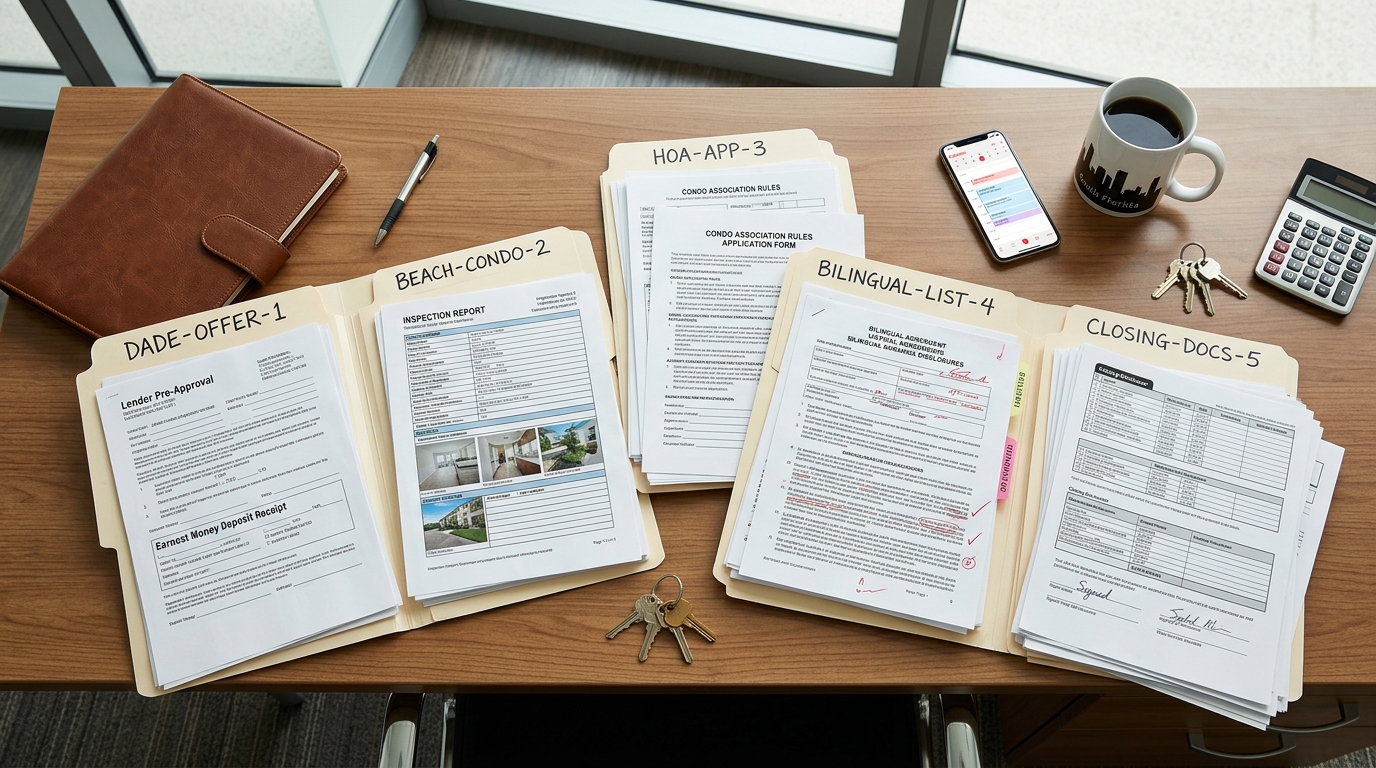

Your one-deal system wasn't designed for this
Most agents build their paperwork habits around a single transaction. You learn the sequence — listing agreement, disclosures, offer, contract, inspections, appraisal, clear to close — and you develop a feel for where you are in the process. Maybe you use a checklist. Maybe you keep a mental model. Either way, it works.
The problem is that this system is serial. It assumes you're focused on one deal moving through stages in order. When you add a second deal, you're essentially running two serial processes in parallel, and your brain is doing the context-switching. When you add a third, the context-switching cost starts eating into your accuracy.
This isn't a discipline problem. It's a systems problem. The checklist that works for one deal doesn't tell you which of your three deals has a disclosure due tomorrow. Your email inbox doesn't sort itself by transaction. Your memory — which honestly carried you through the first deal and a half — starts dropping things.
And here's what makes it tricky: nothing feels broken yet. You're just a little behind. A little less sure about which document went where. A little more dependent on scrambling at the last minute instead of staying ahead. That gap between 'feels manageable' and 'actually under control' is where the real risk lives.
Cross-contamination: the quiet killer
The most common multi-deal paperwork failure isn't a missing document. It's a misrouted one. You send the seller disclosure for 742 Elm to the buyer on your Oak Street deal. You attach the wrong inspection report to a lender email. You copy the repair addendum from deal A, update it for deal B, but forget to change the property address in the header.
These are small errors. Individually, most of them get caught and corrected with a quick apology. But they create a pattern that erodes trust. Your client starts double-checking things you send. The title company flags your file. The lender asks for 'the correct version this time.' None of these people are going to fire you over one mistake, but they're all quietly recalibrating how much they trust your paperwork.
Cross-contamination gets worse when you're working deals at similar stages. Two closings in the same week? Three deals all in the inspection-to-appraisal corridor at the same time? That's when the documents start to blur together, because you're doing the same types of tasks for different transactions on the same day.
The fix isn't just 'be more careful.' Careful doesn't scale. When you're managing paperwork across multiple real estate deals, you need a system that physically separates the transactions — not just different folders, but different tracking streams that prevent you from accidentally crossing wires.
Deadline stacking and the illusion of breathing room
When you take on a new deal, you look at the calendar and think: 'The inspection deadline on deal A is the 8th, the disclosure deadline on deal B is the 12th, and deal C doesn't close until the 22nd. I have room.' Then the inspection on deal A gets delayed two days. The seller on deal B is slow returning documents. And suddenly the 10th through the 14th is a five-day window where every deal needs something urgent from you at the same time.
This is deadline stacking, and it's the most predictable failure point in multi-deal management. Real estate transactions don't move on your schedule. They move on the schedule dictated by inspectors, lenders, title companies, and the other side's agent. When three transactions are all subject to external timing, you can't predict when the pressure will compress.
What makes deadline stacking dangerous is that the consequences are asymmetric. Missing a disclosure deadline by one day might mean a contract extension — annoying but survivable. Missing it by three days because you were buried in another deal's appraisal dispute could give the other party a legal out. The stakes are different for every deadline, but when you're stacking them, you lose the ability to triage because you can't remember which deadlines carry the most risk.
Agents who consistently handle high volume don't do it by working harder during the stacks. They do it by seeing the stacks coming and front-loading work before the window compresses. That requires visibility across all your deals at once — not just the one that's loudest right now.
The lender loop and version control nightmares
Lenders are paperwork machines. They request documents, review them, request revisions, and request the same documents again two weeks later because the file moved to a different underwriter. That's manageable with one deal. With three deals going through lending simultaneously, you're now tracking multiple document request threads with different lenders, each with their own portal, their own formatting preferences, and their own definition of 'most recent.'
Version control becomes a real problem here. You update the purchase agreement on deal B, send it to the lender, then realize the title company also needs the updated version. But you already sent title the previous version an hour ago. Now there are two versions of the same document floating in two different inboxes for the same deal. Multiply that by three active transactions.
The agents who get burned here aren't the ones who lose documents entirely. They're the ones who send the right document to the right person — but the wrong version. A purchase price that was renegotiated after inspection. A closing date that shifted by a week. An addendum that was signed but never replaced the unsigned draft in the file. These are the kind of paperwork mistakes that cost agents more than just time — they can delay closings and damage professional relationships.
If you're running three or more deals, you need a single source of truth for each transaction's documents. Not your email. Not your downloads folder. A system where the current version of every document is clearly identified and accessible without hunting.
The 'I'll remember' trap
At one deal, your memory is an asset. You know the buyer's name, the seller's concern, the inspection date, the lender's quirks. You carry the whole deal in your head and you're responsive because the answers are right there.
At three deals, your memory becomes a liability. You remember that someone needed a signed addendum by Friday, but you can't immediately recall which deal, which addendum, or which Friday. You remember a conversation about a repair credit but have to check two different email threads to find the number. You're sure you sent the HOA docs, but now you're not sure if it was this deal or the other condo deal.
This is the 'I'll remember' trap, and it's the leading indicator that your paperwork system is about to fail. When you start relying on your memory to track document states across multiple transactions, you've already crossed the line from 'managing' to 'surviving.'
The warning signs are specific: you find yourself re-reading old emails to reconstruct a timeline. You ask a client or a lender a question you already asked last week. You stay up late on a Sunday re-checking files because you have a nagging feeling you forgot something. These aren't signs that you're bad at your job. They're signs that your system wasn't built for this volume.
What the early warning signs actually look like
The collapse doesn't announce itself. It shows up as a series of small symptoms that are easy to explain away individually but tell a clear story when you see them together. Here's what to watch for:
You start batching document work at the end of the day instead of handling it in real time. This feels like efficiency but it's actually avoidance — you're pushing paperwork into a single block because context-switching between deals during the day has become too mentally expensive.
Your response time to lenders, title companies, and cooperating agents starts slipping. Not by days, but by hours. Where you used to respond same-morning, now it's afternoon. Where it was afternoon, now it's next-day. Each slip is small, but the people on the other end notice.
You have a growing list of 'things to double-check' that you never actually check. This is the clearest sign. If you're carrying a mental queue of document verifications — did I send the right version, did I get that signature, did I forward the amendment — and that queue keeps growing instead of clearing, you're already behind.
You feel a low-grade anxiety about your deals that you can't pin to a specific problem. This is the compound effect. Your brain knows something isn't tracked properly, but it can't identify what. That ambient stress is a signal, not just a feeling.
Building a system that scales past two deals
The solution isn't heroic effort. It's separation and visibility. Every concurrent deal needs its own clearly defined tracking stream — documents, deadlines, communications, and status — that you can review independently without contamination from the other deals.
Start with the basics: no shared folders, no combined to-do lists, no 'I'll sort this later' email tagging. Each deal should have its own document trail where you can instantly see what's been sent, what's pending, and what's overdue. If you can't answer those three questions for any deal in under sixty seconds, your system has a gap.
Next, build in cross-deal visibility. You need a single view — a dashboard, a spreadsheet, whatever works — that shows you the upcoming deadlines across all active deals. Not just the next task for each deal, but the next two weeks of obligations across all of them. This is how you spot deadline stacks before they hit.
Finally, automate the reminders. Not the work itself — but the awareness. You should never find out about a deadline because you happened to check. You should find out because something told you. Whether that's a calendar alert, a task management tool, or an AI-powered assistant that tracks document states for you, the principle is the same: your attention should be directed, not scattered.
If you're curious about where AI tools can genuinely help with this kind of tracking — and where you still need to verify things yourself — that's worth understanding before you rely on any single system.
The real cost isn't the mistake — it's the pattern
One wrong addendum is a correction email. A pattern of wrong addenda is a reputation problem. One missed deadline is a contract extension. A pattern of missed deadlines is a reason for a client to pick a different agent next time.
The cost of multi-deal paperwork failures isn't usually dramatic enough to show up in a single transaction. It's cumulative. It shows up in the title company that stops giving you the benefit of the doubt. The lender who starts padding timelines because they expect delays from your side. The past client who liked you personally but felt like the transaction was disorganized and doesn't refer you as enthusiastically as they would have.
This is why catching the bottleneck early matters more than fixing individual mistakes. By the time you're scrambling to correct errors at closing, the damage is already baked into how people experience working with you. The agents who scale past three, five, ten concurrent deals aren't making fewer mistakes because they're more talented. They're making fewer mistakes because they built systems that prevent the most common failure points from occurring in the first place.
That's the actual competitive advantage in a high-volume real estate practice. Not working more hours. Not being more disciplined. Having a paperwork system that doesn't degrade under load.