The five disclosure questions that stall Spanish-dominant sellers
Not every question on the FAR Seller's Property Disclosure form creates confusion. Most yes/no items about plumbing, roof condition, or appliance age are straightforward. The stall happens at five specific questions where legal English has no intuitive Spanish equivalent — and where the seller senses the answer carries real weight but doesn't understand exactly what's being asked.
| Disclosure question area | Why it stalls Spanish-dominant sellers | The term with no clean equivalent |
|---|---|---|
| Prior insurance claims (CLUE history) | Sellers don't connect past claims to current disclosure obligations — "reclamación de seguro" doesn't carry the same legal implication | Material claim / CLUE report |
| Known defects: latent vs. patent | The legal distinction between hidden and visible defects has no everyday Spanish phrasing — sellers freeze because they don't know what counts | Latent defect / defecto latente oculto |
| Environmental hazards (lead paint, mold, radon) | Federal lead-based paint disclosure under 42 U.S.C. § 4852d uses specific language that doesn't translate to conversational Spanish | Lead-based paint disclosure / divulgación de pintura con plomo |
| HOA violation history | Sellers often don't realize unresolved violations show on estoppel letters and must be disclosed — "violación de HOA" sounds more severe than the form intends | Estoppel letter / carta de estoppel |
| Permit status for improvements | "Mejoras con permiso" vs. "mejoras sin permiso" isn't how families discuss renovations — they think in terms of what was built, not what was permitted | Permitted improvement / mejora con permiso |
Each of these questions requires scenario-based explanation, not just translation. Telling a seller that "latent defect" means "defecto oculto" doesn't help if they can't picture what qualifies. They need an example: the foundation crack behind the drywall you patched in 2019 — that's a latent defect. The stain on the ceiling the buyer can see — that's patent. Without that kind of walkthrough, they leave the question blank or answer incorrectly.
The liability risk you're creating with verbal-only explanations
Here's the problem most bilingual listing agents don't think about until it's too late. When you walk a Spanish-dominant seller through the disclosure form over the phone, your verbal explanation is the only record of what was communicated. If that seller later misrepresents a known defect — because they misunderstood your explanation — both of you carry post-closing exposure.
Florida's seller disclosure duty, established in Johnson v. Davis, requires sellers to disclose known material facts. NAR's Code of Ethics Article 1 obligates you to provide competent service. If a buyer discovers an undisclosed defect after closing and the seller says "my agent explained the form to me in Spanish," the question becomes: what exactly did you say? Without documentation, your E&O insurer has nothing to work with.
A verbal explanation that differs from the English form language — even slightly — creates an undocumented gap between what the seller understood and what the form actually says. That gap is where post-closing claims live.
This is why a written Spanish-language briefing — sent before the form — matters beyond just speed. It creates a documentation trail showing what concepts were explained, in what language, before the seller answered. That trail protects both parties. This connects directly to the broader verbal explanation layer that bilingual deals require, which we've covered in depth in our breakdown of why bilingual documents need a verbal explanation layer.
The family consultation loop: the hidden 3–5 day delay
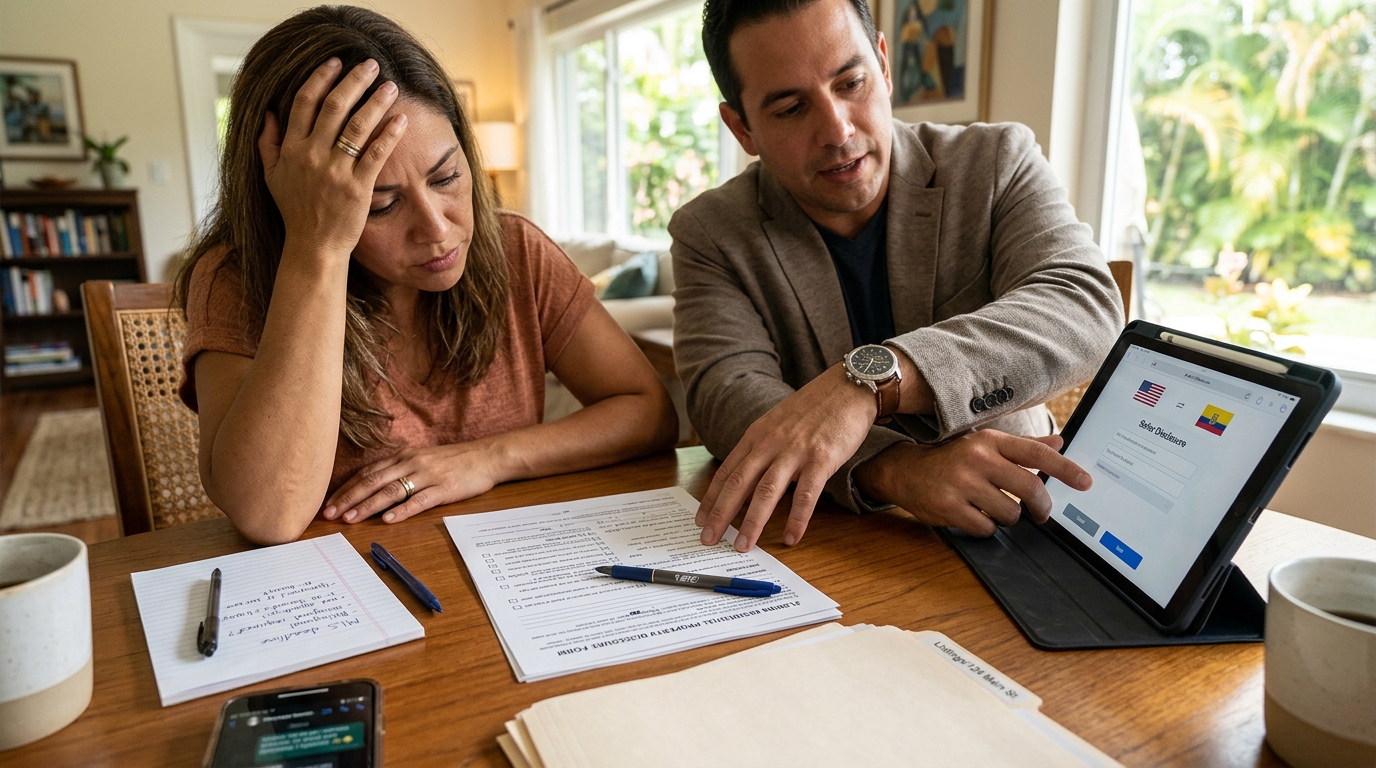
In many Spanish-speaking households, the seller doesn't make disclosure decisions alone. They discuss answers with a spouse, an adult child who's more comfortable in English, or a family advisor who wasn't at the listing appointment. This consultation loop adds 3–5 days to turnaround — and most agents don't plan for it because it doesn't happen in monolingual deals.
The pattern is consistent. The seller receives the form, fills out the easy questions, hits one of the five confusing items, sets the form aside, and waits until the weekend when the family gathers. The family member reads the question, offers their interpretation, and the seller either completes the form or calls you for clarification. That cycle eats a full week before you even know it's happening.
- The seller's adult daughter translates the form but doesn't understand the legal distinction between latent and patent defects — she guesses
- The seller's spouse wasn't at the listing appointment and wants to understand why certain questions matter before signing anything
- A family advisor — often an uncle or cousin who bought property years ago — offers outdated guidance about what needs to be disclosed
- The seller waits for a family gathering rather than making individual calls, pushing the timeline to the next weekend
A briefing packet that the seller can hand to their family solves this without requiring you to attend a second meeting or take a 45-minute call. The family reads the same plain-language explanations you would have given verbally, and the consultation happens with context instead of confusion. This is a pattern we see across bilingual deals — friction that starts before the contract even exists. We've mapped more of these pre-contract friction points for bilingual agents.
The pre-listing disclosure briefing packet: what to include
The fix is a one-page Spanish-language briefing document that you send to the seller two to three days before the actual disclosure form. Not a translation of the form — a preparation guide that sets context. The seller reads it, shares it with family, and arrives at the disclosure form already understanding what they'll be asked and why.
- A plain-language explanation of what the disclosure form is and why Florida law requires it — one paragraph, no legal jargon, in Spanish
- The five confusing questions listed by name with a real-world example for each: "If you patched a wall crack in 2020 and the crack came back, that's a known defect you need to disclose"
- A clear statement that AS-IS contracts do not eliminate disclosure obligations — this single sentence prevents the most dangerous misunderstanding
- A specific return deadline with the date written out: "Please return the completed form by [fecha] so we can list the property on [fecha]"
- A note encouraging the seller to share this briefing with anyone who will help them fill out the form — spouse, child, advisor
This packet doesn't replace the formal English disclosure form — it prepares the seller for it. When the actual form arrives two days later, the seller recognizes the questions, already has answers discussed with family, and returns it faster. We've seen this approach cut average turnaround from 10+ days to under 5 in bilingual listings without adding any time to the agent's schedule per listing.
Track it like a system, not a to-do
Sending the briefing packet is the intervention. But if you're running three or four bilingual listings at once, you also need a system that tracks where each disclosure stands — otherwise you're back to manually chasing forms and losing 2–3 hours per listing on follow-up.
| Day | Action | Channel |
|---|---|---|
| Day 0 | Send Spanish briefing packet with deadline date | WhatsApp PDF + voice note |
| Day 2 | Send the actual FAR disclosure form | Email + WhatsApp link |
| Day 4 | Bilingual reminder: "¿Tiene alguna pregunta sobre el formulario?" | WhatsApp text |
| Day 5 (deadline) | Alert to agent if form not returned — personal follow-up call | Agent notification |
| Day 6+ | Escalation: offer a 15-minute walkthrough call for remaining questions only | Phone |
The key difference between this and what most agents do now: you're not calling on day 1 to walk through the entire form. You're only calling on day 5 or 6, and only for the specific questions the seller still has — because the briefing packet already handled 80% of the confusion. That's the difference between a 45-minute phone call per listing and a 10-minute one.
This is informational guidance for your workflow — it's not legal advice. Disclosure obligations vary by state and transaction type. Always verify specific requirements with a licensed attorney or your brokerage's compliance team, especially when working across language barriers where misunderstandings carry outsized risk.
What this looks like at scale
One bilingual listing with a disclosure delay is an inconvenience. Four at once is a systems failure. The briefing packet solves the per-listing confusion, but the tracking system is what keeps multiple listings from stacking up into a week of chasing forms instead of selling.
- Each listing gets a disclosure status tag: briefing sent → form sent → reminder sent → returned or escalated
- Bilingual reminders go out automatically at the intervals above — you don't have to remember which listing is on day 4
- The agent gets a single alert only when a deadline passes, so attention goes where it's needed
- Time-per-listing on disclosure follow-up drops from 2–3 hours of scattered calls to under 30 minutes of targeted check-ins
The goal is simple: your Spanish-dominant seller returns a complete, accurate disclosure form within five days of receiving it, without you spending more time per listing than you would on a monolingual deal. The briefing packet gives them understanding. The tracking system gives you visibility. Together, they turn a consistent 10-day delay into a solved problem.