Dashboard fatigue is why agents abandon AI tools
Think about the last real estate tool you tried. Structurely, kvCORE, LionDesk, Follow Up Boss — each one came with its own login, its own dashboard, its own learning curve. The tool might have been good. The problem was where it lived: somewhere else.
NAR survey data consistently shows agents use five or more platforms daily. Every additional tab is a context switch. Every context switch is a moment you could have spent on a client call, a negotiation, or a showing. The tool does not compete with paperwork — it competes with your attention.
The fastest way to kill adoption is to ask an agent to leave the app they are already in. If the tool is not where the work happens, the tool does not get used.
This is not a discipline problem. It is a design problem. And it is exactly what we set out to solve when building Reddy. Instead of asking agents to come to the software, we brought the software to where agents already work: WhatsApp, Telegram, and email.
What 'works inside your chat' actually means
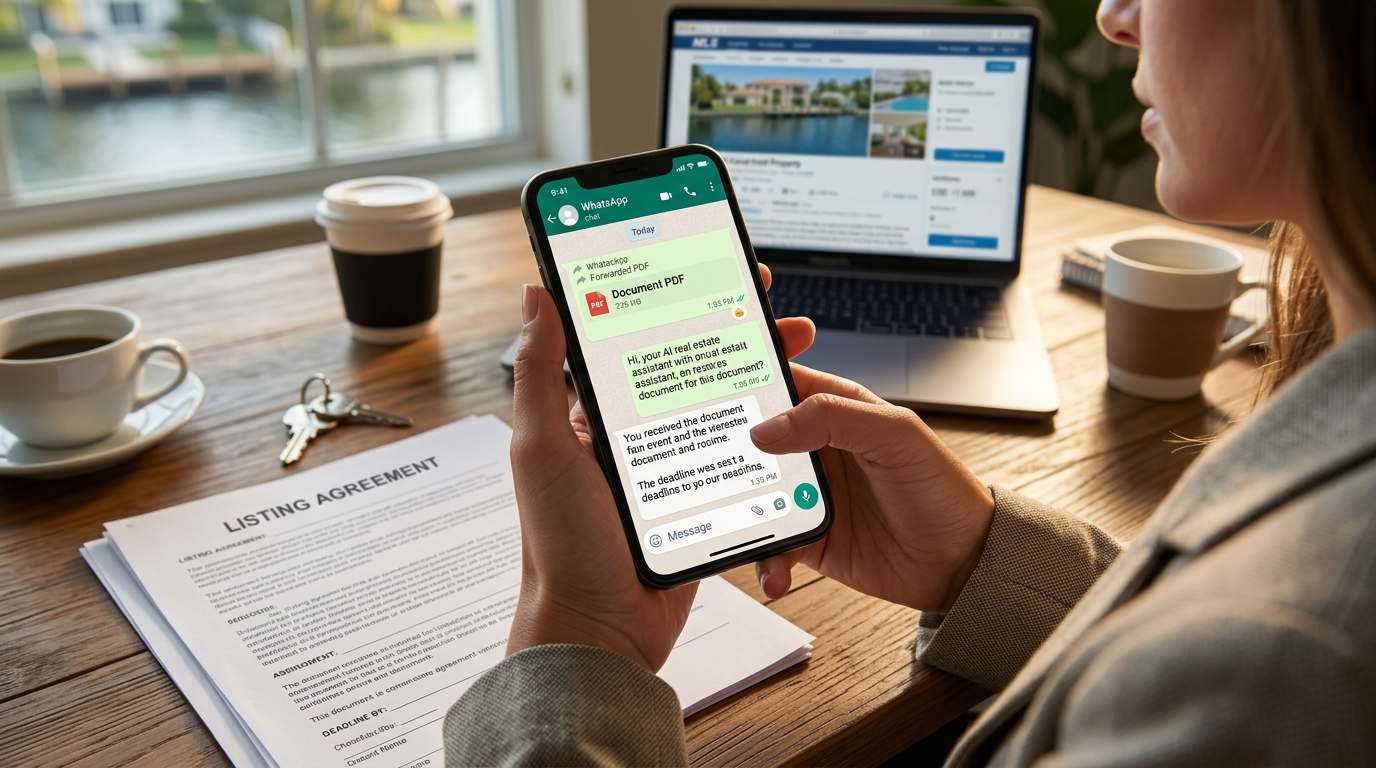
Most AI tools that mention WhatsApp or Telegram use them as notification channels — a ping that sends you back to a dashboard. Reddy uses them as the primary operating interface. The conversation is the workspace.
Here is what that looks like in practice, across three real input types agents use every day:
| Input | What the agent does | What Reddy does |
|---|---|---|
| Contract PDF | Forwards it to the Reddy chat in WhatsApp or Telegram | Extracts key dates, parties, contingency deadlines — files the document and sets reminders automatically |
| Voice note | Records a 30-second note: 'Inspection for 742 Flamingo is Thursday at 2, need the report by Monday' | Transcribes the note, creates the task with the deadline, and confirms back in the same thread |
| Text message | Types: 'Push the appraisal deadline for the Coral Gables deal to June 3' | Updates the deadline, notifies relevant parties if configured, and confirms the change |
| Email forward | Forwards a lender update from Gmail to Reddy's email address | Parses the update, logs it against the correct transaction, and flags any new action items |
Voice notes are data — not just audio files
This is the coverage gap nobody talks about. Agents send voice notes constantly — it is faster than typing, especially between showings or while driving. But every AI tool on the market treats those voice notes as dead-end audio. They sit in the chat, unindexed, unsearchable, unactionable.
Reddy processes voice notes through voice-to-text parsing and then extracts structured information: dates, property addresses, task descriptions, party names. A 20-second voice note becomes a logged task with a deadline attached to the right transaction.
We built this because we kept hearing the same thing from agents in South Florida: 'I already told my TC everything in a voice note — why do I have to type it again into a form?' You should not have to. That is the point.
The friction gap: dashboard vs. chat
The difference between a tool agents use and a tool agents abandon usually is not about features. It is about friction. Here is the actual step comparison for a common task: logging a new inspection deadline.
| Step | Dashboard-based tool | Reddy in chat |
|---|---|---|
| 1 | Open browser or app | Open WhatsApp (already open) |
| 2 | Log in or switch accounts | Find the Reddy thread (pinned) |
| 3 | Navigate to the correct transaction | Type or voice-note: 'Inspection for 742 Flamingo, Thursday 2pm, report due Monday' |
| 4 | Find the deadline field and enter the date | Done — Reddy confirms in the same thread |
| 5 | Save, close, return to your messaging app | — |
This matters most when agents are juggling multiple deals. If you are running five concurrent closings — which is normal for a productive agent — the compound friction of switching into a dashboard for every small update is the reason things get skipped. Missed deadlines are rarely about forgetting. They are about the update being too annoying to log in the moment. We wrote about this pattern in detail in our breakdown of where AI actually saves agents 15 hours a week.
Tools like Zapier and Make try to bridge this gap by connecting apps together. But they still require someone to build and maintain the automations. Reddy removes the plumbing entirely — the messaging app is the interface, not a trigger for another system.
What about security and record-keeping?
Running transaction data through WhatsApp and Telegram raises a fair question: is this safe? It is a question the existing AI-for-real-estate content almost never addresses, and it deserves a straight answer.
- WhatsApp messages are protected by end-to-end encryption by default. Documents forwarded to Reddy travel over the same encrypted channel your client conversations already use.
- Reddy stores transaction data separately from the messaging platform — the chat is the input interface, not the database. Records are maintained in a structured system that supports retrieval and audit.
- Email forwarding through Gmail or Google Workspace follows standard TLS encryption in transit. Sensitive documents should be handled with the same care you would use forwarding to a human TC.
- State-level record-keeping requirements vary. Reddy is designed to support document retention, but agents should verify compliance with their brokerage's specific policies and their state's regulations.
The short version: the security profile of sending a contract to Reddy over WhatsApp is comparable to sending it to a human transaction coordinator over the same channel — which most agents already do daily.
This is not about AI novelty — it is about where work gets done
The real estate AI market is full of tools that are technically impressive and operationally irrelevant. ChatGPT can draft a listing description. Structurely can qualify a lead. But if the tool lives in a separate window, it is fighting for the same scarce resource every agent is short on: attention.
Reddy is built on a simpler thesis. The best admin tool for an agent is one that fits inside the workflow that already exists — not one that asks the agent to build a new workflow around it. We have written before about why AI cannot fix a broken workflow. The inverse is also true: a well-designed AI should not require you to change yours.
The question is not whether AI can help real estate agents. It is whether the AI lives where the agent works — or somewhere the agent has to remember to go.
If your admin workflow already runs through WhatsApp, Telegram, and email, Reddy meets you there. No dashboard. No new login. Just the work, handled, inside the conversation you were already having.