
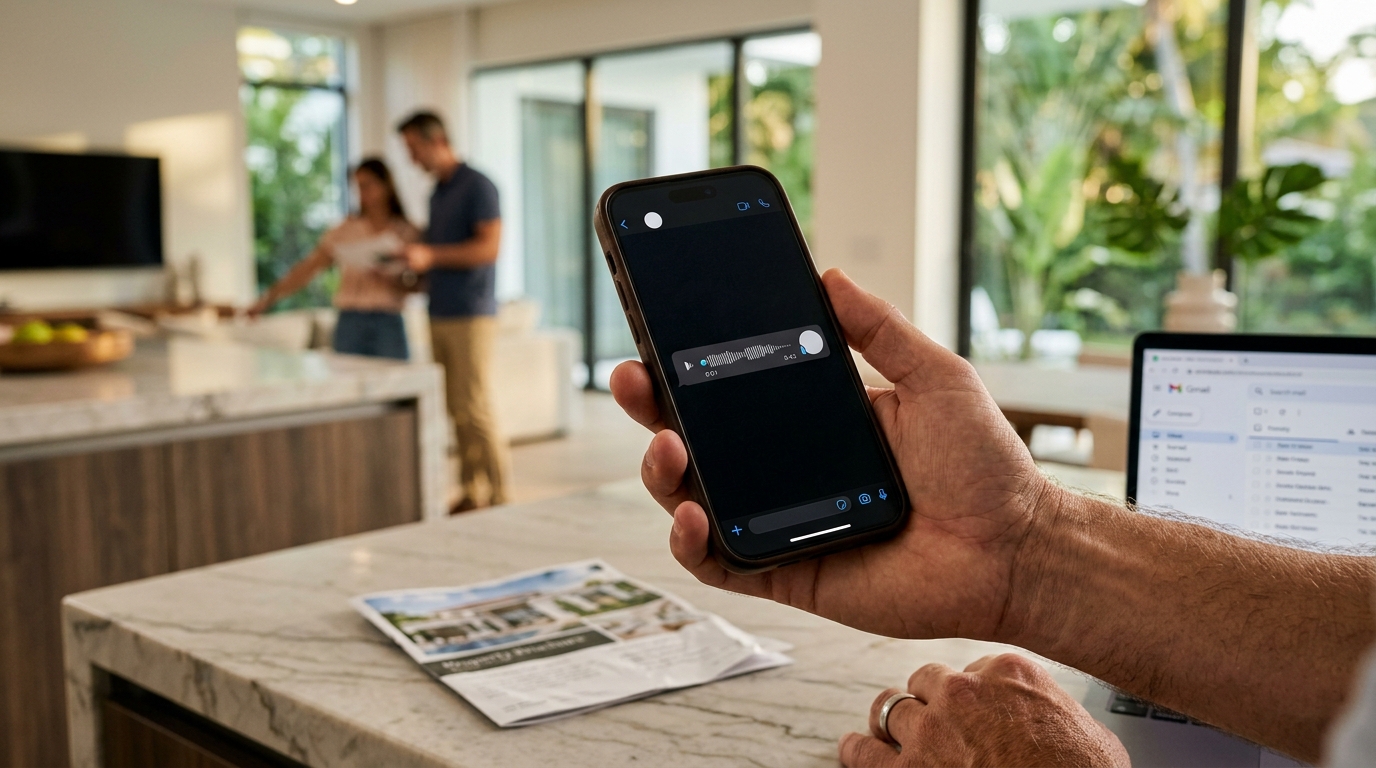
What actually gets lost in voice-note communication
Most agents we talk to estimate they exchange 20–40 voice notes per active deal. That number climbs fast for bilingual agents whose clients prefer speaking Spanish over typing English. The messages aren't small talk — they carry offer details, financing updates, inspection concerns, and scheduling changes.
The problem isn't that you forget the information exists. It's that the information never crosses into a system where it can be tracked, referenced, or acted on by someone other than you. Your lender says "we got the clear-to-close" in a 45-second WhatsApp voice note, and that update lives nowhere except your memory and a chat thread you'll never scroll back to.
- A co-op agent verbally adjusts the closing date — you mentally note it but never update Dotloop or SkySlope.
- A client describes their concerns about an HOA restriction in a two-minute voice memo — you forget half the details by the next showing.
- A lender sends a spoken pre-approval update with a revised number — the deal file still shows the old figure.
- A client mixes Spanish and English in a single voice note explaining what repairs they'll accept — nobody else on your team can parse it.
Voice notes aren't a communication problem. They're a data-capture problem disguised as a communication preference.
The voice-to-action chain: where each link breaks
Getting from a raw voice note to a structured deal action involves four steps. Most agents stall at step one or two — not because the tools don't exist, but because the steps aren't connected.
| Step | What happens | Where it usually breaks |
|---|---|---|
| 1. Capture | Voice note is received on WhatsApp, iMessage, or Telegram | Message stays in the chat app — no export path to a work system |
| 2. Transcribe | Audio is converted to text | Works well for clean English; degrades with background noise, code-switching, or real estate jargon (escrow, HOA, contingency) |
| 3. Extract | Key details are pulled from the transcript — dates, dollar amounts, names, action items | Most transcription tools stop at raw text; they don't identify what matters for the deal |
| 4. Route | Extracted data lands in the right place — deal file, checklist, follow-up task, CRM note | Almost no one automates this step; it requires manual copy-paste or re-entry |
Tools like Otter.ai, WisprFlow, and OpenAI's Whisper model handle step two well for clean, single-language audio. Voiset and OpenClaw attempt steps three and four — converting spoken notes into tasks, calendar events, and CRM entries. But none of these tools were built for the specific structure of a real estate deal, where a verbal update needs to land on a specific contingency line or checklist item in your transaction management system.
Why bilingual voice notes break differently
For agents working South Florida, Houston, or any market with a large Spanish-speaking client base, voice notes are often the default communication channel. Clients who are comfortable speaking but less comfortable writing in English will send 90-second voice memos in Spanish — or, more commonly, in a mix of both languages within the same message.
Code-switching is the specific technical problem. A client might say "the seller agreed to fix el techo pero no the plumbing" in a single breath. Generic transcription tools either pick one language and garble the other, or produce a transcript that's technically accurate in neither. Real estate terms make it worse — "escrow" doesn't translate cleanly, "HOA" stays as an acronym, and property addresses are proper nouns that trip up language models.
- OpenAI Whisper handles single-language Spanish well but struggles with mid-sentence language switches.
- Most CRM integrations (Follow Up Boss, HubSpot, Salesforce) only accept notes in one language — there's no bilingual field or auto-translated summary.
- A translated transcript still requires someone to decide which details are deal-relevant and where they belong in the file.
We've written before about how bilingual operations aren't just a translation problem — they're a workflow problem. Voice notes are where that distinction is sharpest. The issue isn't converting Spanish audio to English text. It's converting a client's spoken intent into a structured action in your deal system, regardless of which language they used.
A practical voice-note audit before you buy anything
Before you sign up for another AI tool, spend one week tracking your voice-note volume. Most agents are surprised by the numbers — and by how much deal-critical information lives only in audio.
- Pick three active deals and count every voice note sent and received over five business days. Include WhatsApp, iMessage, Telegram, and any other channel you use.
- Tag each message as one of four types: scheduling, deal-critical update (price, terms, contingency, financing), question requiring follow-up, or social/non-actionable.
- For each deal-critical message, check whether the information made it into your deal file, CRM, or transaction management system. Note which ones didn't.
- Estimate the time cost: how many minutes did you spend re-listening, re-asking, or manually entering information that was already communicated verbally?
- Multiply that time across your average monthly deal volume. That's your voice-note tax — the hidden admin load that doesn't show up in any productivity tracker.
This audit also tells you which step in the voice-to-action chain matters most for your workflow. If most of your lost information is scheduling, a simple voice-to-calendar tool like Voiset might be enough. If it's deal terms and contingency updates, you need extraction and routing — not just transcription. Understanding where your specific chain breaks helps you avoid buying a tool that solves the wrong step.
Compliance realities most agents are ignoring
Every article about AI voice tools focuses on the upside. Almost none mention what happens when you start processing and storing client voice messages systematically — especially messages received on personal WhatsApp accounts.
- TCPA governs outbound calls and texts, but broker record-retention policies may also apply to incoming voice messages that contain material deal terms.
- If a client mentions their financial situation, pre-approval amount, or credit concerns in a voice note, that information may fall under data-handling obligations your brokerage has agreed to.
- WhatsApp Business API has different data-processing rules than personal WhatsApp. Most agents use personal accounts, which means any third-party tool accessing those messages operates in a gray area.
- NAR's Code of Ethics requires preservation of certain transaction records. Whether voice notes count depends on your broker's interpretation, but "I didn't save it" is not a strong compliance position.
The practical takeaway: if you're going to build a voice-note workflow, build it on infrastructure your broker can see and approve. That means moving communication to WhatsApp Business API where possible, using tools with clear data-handling policies, and keeping a human in the loop for anything that touches contract terms. We've covered the broader trust-and-verify framework for AI outputs in real estate before — the same principles apply here.
What a realistic voice-note workflow looks like today
There is no single tool that handles the full voice-to-action chain for real estate deals. But you can stitch together a workflow that captures most of what's currently falling through the cracks — if you're honest about where human review is still required.
| Layer | Tool options | What it handles | What it doesn't |
|---|---|---|---|
| Transcription | Otter.ai, OpenAI Whisper, WisprFlow | Speech-to-text for clean audio in one language | Code-switching, heavy background noise, proper nouns |
| Task extraction | Voiset, OpenClaw | Pulls action items, dates, and reminders from transcripts | Doesn't know your deal structure or which contingency a verbal update belongs to |
| Routing & automation | Zapier, Make | Connects transcription output to CRM (Follow Up Boss, HubSpot, Salesforce) or Google Docs | Requires manual setup per workflow; no built-in real estate logic |
| Deal file entry | Manual or semi-automated via Dotloop / SkySlope integrations | Gets data into your transaction management system | Still needs a human to verify accuracy and place info on the right checklist item |
The honest gap: nobody has built the extraction-to-deal-file bridge that understands real estate transaction structure natively. That's the layer where a lender's verbal clear-to-close gets mapped to the financing contingency line in your deal checklist — automatically. It's the hardest step, and it's where we see the most time lost across agents juggling multiple deals.
If you're losing hours each week to voice-note admin and want to understand exactly where AI can take work off your plate today — not in some future product roadmap — that's what we help agents figure out. The time savings are real, but they come from knowing which steps to automate and which ones still need you.