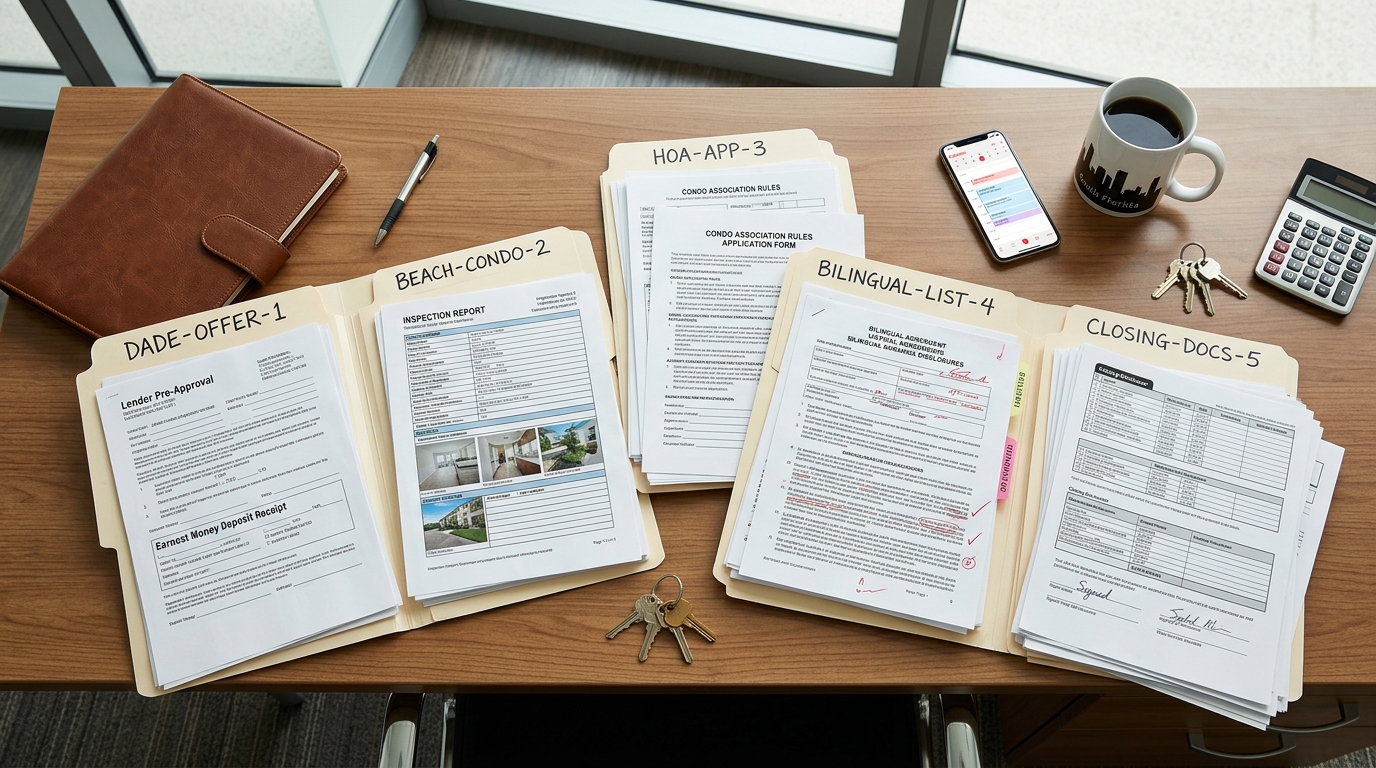

The real cost of chasing documents
Let's put a number on this. Say you have eight active transactions. Each one has at least two or three documents that require client action — signatures, disclosures, inspection responses, repair addendums. Even if only half of those require a follow-up beyond the initial send, you're looking at a dozen reminder conversations happening in parallel.
Each one takes a few minutes. But "a few minutes" spread across texts, emails, calls, and mental tracking adds up to five, eight, sometimes ten hours a week. That's not an exaggeration — it's what agents consistently report when they actually track their admin time.
Those aren't just lost hours. They're lost hours during business days, during the exact windows when you could be on the phone with a new lead or showing a property. Document follow-up doesn't happen at 10 PM. It happens at 2 PM on a Wednesday, right when it competes with everything that actually grows your business.
And the downstream cost is real, too. A disclosure that comes back three days late can push an inspection deadline. A late signature on a repair addendum can stall a closing by a week. One delayed document doesn't just delay one step — it cascades. If you've ever had to explain to a listing agent why your buyer's side is dragging, you know how that feels.
Why your current reminders get ignored
Here's the uncomfortable truth: most reminder emails and texts from agents read like the same message on repeat. "Hi! Just wanted to check in on that disclosure. Let me know if you have any questions!" The first time, it's helpful. The second time, it's background noise. By the third time, the client's brain has fully categorized it as low-urgency.
This happens because of a few specific failure patterns:
No clear deadline. If your reminder doesn't include a specific date by which the document needs to be returned, the client mentally files it as "whenever I get around to it." Vague urgency is no urgency at all.
Too much friction. If the client has to open an email, find an attachment, print it, sign it, scan it, and send it back — or even just figure out which of the four documents you sent last week is the one you're asking about now — they'll put it off. Every extra step is a reason to delay.
Wrong channel at the wrong time. A reminder email sent at 9 AM on a Monday gets buried under fifty other emails by lunch. A text at 8 PM on a Friday might get seen but won't get acted on. The channel and timing aren't trivial details — they're the difference between action and another day of waiting.
No consequence framing. Clients don't usually understand what happens when a document is late. They think it's just paperwork. They don't realize it can shift their closing date, trigger penalty clauses, or create problems with the lender. If you don't connect the delay to something they care about, they won't treat it as urgent.
Identical tone every time. When every follow-up sounds the same — friendly, casual, low-pressure — there's no signal that urgency is increasing. Your fifth reminder reads exactly like your first one, and the client has no reason to treat it differently.
What actually makes a reminder work
Effective document reminders share a few traits, and none of them involve being pushy or aggressive. They're just clearer.
They name the specific document. Not "the paperwork I sent over" — the actual name. "The Seller's Disclosure for 742 Evergreen Terrace." Specificity removes ambiguity and makes the task feel concrete instead of abstract.
They state a deadline and why it matters. "I need this back by Thursday the 14th so we stay on track for our March 28th closing" is ten times more effective than "when you get a chance." You're not nagging — you're giving context. Most clients genuinely don't know the downstream dependencies.
They reduce the number of steps to one. The ideal reminder contains a direct link to sign, or a single attachment with a clear instruction. If the client can complete the task in under two minutes without leaving the message, your return rate goes up dramatically.
They use the right channel for the moment. Email works well for initial sends with attachments. Text works better for short follow-ups and deadline nudges. A phone call signals real escalation and should be reserved for when it's actually needed — not as a first resort.
They escalate in tone gradually. The first reminder can be friendly and informational. The second should be slightly more direct, with the deadline repeated. The third should explicitly name the consequence: "If I don't have this by end of day Friday, the lender will need to push the appraisal review, and we could lose our closing date." That's not being aggressive — it's being honest.
A reminder sequence you can steal
Here's a practical structure you can adapt for most document types. The specific wording will vary, but the skeleton works across transactions.
Send 1 — Day 0 (Initial send): Deliver the document with a clear subject line, the property address, what the document is, what the client needs to do, and the return deadline. Include a direct link or one-click signing option. Set expectations: "I'll check back in on this Thursday if I haven't heard back."
Send 2 — Day 2 or 3 (Gentle nudge, text): A short text. Something like: "Hey [Name], just making sure you saw the Seller's Disclosure I sent Monday for [address]. Need it back by [date] to keep us on schedule. Here's the link again: [link]. Let me know if anything's unclear."
Send 3 — Day 5 (Direct follow-up, email): A brief email that restates the deadline and adds context about why it matters. "We're coming up on the deadline for the disclosure — if it's not submitted by [date], the inspection period could get pushed back, which affects our closing timeline. I want to make sure we stay on track."
Send 4 — Day 6 or 7 (Phone call or voicemail): A short, direct call. "Hi [Name], calling about the Seller's Disclosure for [address]. I need it back by tomorrow to keep us on schedule — if there's anything holding you up, let me know and I can help." This is the first time you pick up the phone, and it signals a real shift in urgency.
Send 5 — Day 8+ (Escalation with consequence): Only if needed. At this point, be explicit: "I want to flag that without this document by [date], our lender/title company/other party will need to [specific consequence]. I want to help you avoid that — can we get this handled today?"
Notice what's different here: each step changes channel, changes tone, and adds new information. You're never sending the same message twice. That's what keeps the client from tuning you out.
The psychology behind the delay
It's tempting to assume clients who don't sign are lazy or careless. Some are. But most of the time, the delay comes from one of three places:
They're overwhelmed by the transaction itself. Buying or selling a home generates a firehose of information — inspections, appraisals, loan docs, insurance quotes, moving logistics. Your disclosure packet lands in the middle of all of that, and it doesn't feel like the most urgent thing. Because to them, it isn't. They don't see the dependency chain you see.
They're confused about what to do. Real estate documents are dense. Clients often don't want to admit they're not sure what they're signing or where to sign. So they set it aside, intending to read it more carefully later, and "later" never comes.
They're avoiding a decision. Sometimes a document requires the client to make a choice — approve a repair, accept a condition, waive a contingency. If they're uncertain, they stall. The document itself becomes the bottleneck because the decision behind it hasn't been made yet.
Understanding which of these is driving the delay changes your follow-up entirely. For overwhelm, you simplify. For confusion, you offer a quick walkthrough. For avoidance, you surface the decision directly and help them think through it. A blanket "just following up!" doesn't address any of these, which is exactly why it doesn't work.
Building a system instead of winging it
The biggest difference between agents who spend two hours a week on document follow-up and agents who spend ten isn't talent or charm — it's whether they have a system or not.
A system means you're not deciding from scratch every time: "Should I send another email? Should I call? How long has it been? Did I already follow up on the disclosure or was that the inspection response?" Those micro-decisions are exhausting, and they multiply across every active deal.
At minimum, a workable system includes three things:
A tracking layer. You need to know, at a glance, which documents are outstanding, when each was sent, and when each is due. A spreadsheet works. A project board works. What doesn't work is relying on your memory or scanning your sent folder.
A default sequence. Having a pre-built reminder cadence — like the one above — means you're not composing each follow-up from scratch. You adjust the details, but the structure and timing are already set. This alone can cut your per-reminder time in half.
A trigger for escalation. Knowing exactly when to move from text to phone, or from friendly to direct, removes the emotional friction of "am I being too pushy?" You're not being pushy — you're following the process. That mental shift matters more than most agents realize.
If you're managing all of this yourself across multiple deals, it's worth reading about the broader admin trap that solo agents fall into — where document follow-up is just one piece of a much larger time drain that compounds silently across your week.
And if you're not sure which documents even need tracking for a given deal type, having a clear paperwork checklist by transaction type can save you from discovering gaps at the worst possible moment.
When the reminder isn't the real problem
Sometimes you can have the perfect reminder sequence and still struggle to get documents back. When that happens, the issue usually isn't follow-up — it's upstream.
The document was sent too early. If you send a disclosure packet before the client feels emotionally invested in the deal, it feels like homework. Timing the initial send to land right after a milestone — accepted offer, completed inspection, appraisal cleared — gives the client a reason to engage.
The client doesn't trust the process. First-time buyers and sellers sometimes hesitate because they're not sure if signing something is binding, irrevocable, or risky. Taking sixty seconds to explain what the document does and what it doesn't do can eliminate days of delay.
There's a relationship gap. If the client doesn't feel like you're on their side, every request feels transactional. Agents who invest in the relationship early — explaining the timeline, previewing what documents are coming, setting expectations about turnaround — find that the documents come back faster with less chasing.
These aren't follow-up fixes. They're process fixes. And they're often more impactful than any individual reminder tweak.
Reclaiming the hours you're losing
Here's the bottom line: document follow-up is real work, but it shouldn't be your primary work. Every hour you spend chasing a signature is an hour you're not spending on the activities that actually generate revenue — prospecting, showing, negotiating, building relationships.
The agents who handle this well don't do it by being more persistent. They do it by being more systematic. They send better initial requests. They follow up on a schedule that escalates predictably. They use the right channel at the right time. And they have a way to track it all without relying on memory.
None of that requires special software or a full-time assistant — though both can help. It does require you to stop treating each reminder as a one-off and start treating document follow-up as a repeatable process that runs the same way every time.
When you do that, two things happen. First, documents come back faster. Second — and this is the part that really matters — you stop feeling like the person who nags. You start feeling like the person who keeps the deal on track. That's a better experience for you, and it's a better experience for your clients.