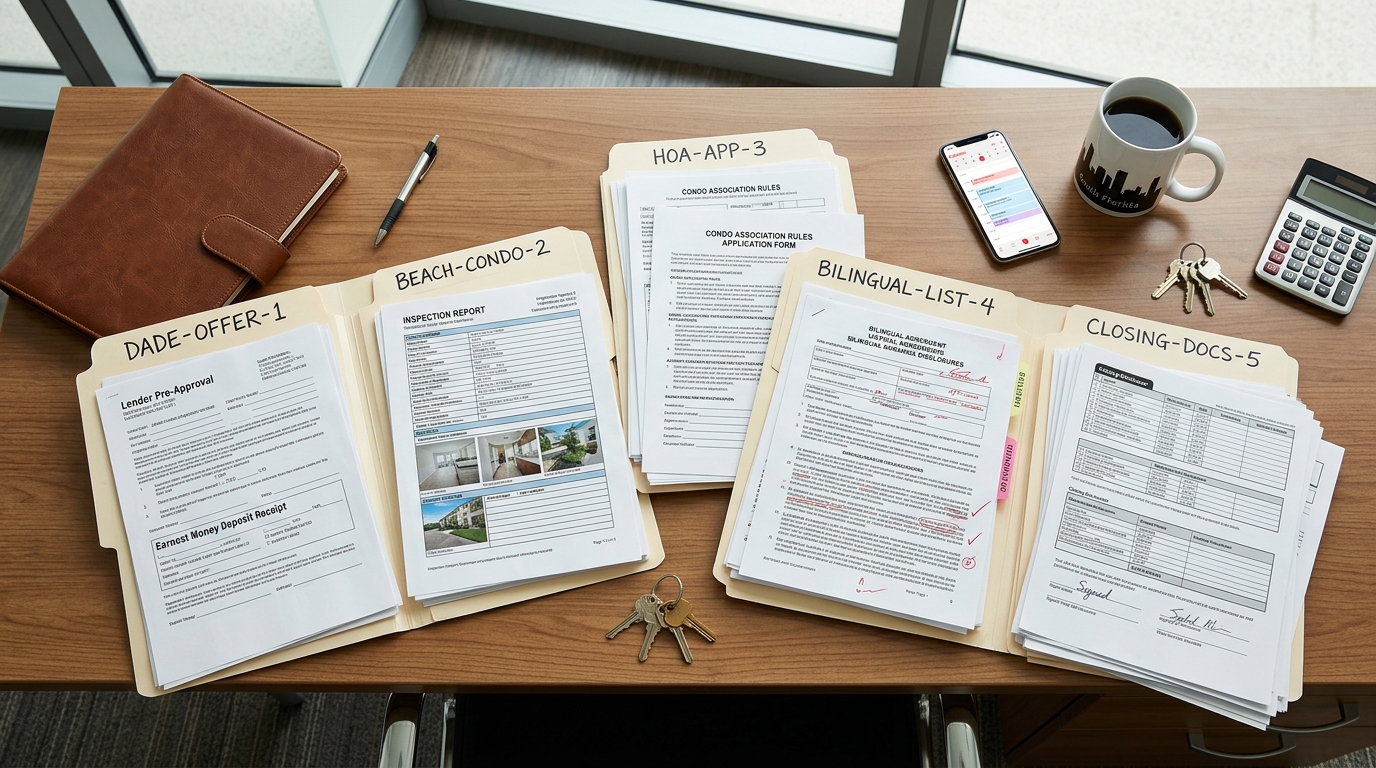

Why one checklist doesn't cut it anymore
If you're running three or four deal types in the same quarter — maybe a couple of resales, a condo listing, a short sale referral, and a rental lease for a past client — a single generic checklist is going to leave gaps. It either includes too much (so you ignore the items that don't apply) or too little (so you miss something deal-specific).
The real cost isn't just the scramble. It's the compliance exposure. A missing seller's disclosure is an inconvenience. A missing lead-paint form on a pre-1978 property is a federal violation. A short sale without a hardship letter stalls for weeks. And a condo deal without the HOA estoppel can blow up title.
Most agents don't need more discipline — they need a better system. One that tells them exactly which documents apply to the deal they're working right now.
The core document set: what almost every deal needs
Before we get into deal-type differences, here's the baseline. These documents show up in nearly every residential real estate transaction, regardless of type:
Listing side (if applicable): Listing agreement, seller's disclosure, lead-based paint disclosure (pre-1978 homes), property survey or plat, MLS data input sheet, agency disclosure, marketing authorization.
Buyer side: Buyer representation agreement, purchase and sale agreement, proof of funds or pre-approval letter, agency disclosure, earnest money receipt.
Closing stage: Title commitment, closing disclosure (CD), deed, settlement statement, wire instructions, final walkthrough confirmation.
Think of this as your foundation layer. Everything below adds to it — or in some cases, replaces parts of it — depending on the deal type.
Residential resale: the standard but not simple stack
This is the deal type most agents know best, and it's the one that breeds the most overconfidence. Because it feels routine, it's easy to assume you've got everything covered. But even standard resales have documents that slip through when you're busy.
Key documents beyond the core set: Home inspection report and repair addendum, appraisal report (if financed), HOA disclosure (if applicable even for single-family in a deed-restricted community), flood zone determination, mortgage commitment letter, title search and title insurance binder.
Common miss: The repair addendum. Agents negotiate repairs verbally or over text, then forget to memorialize the agreement in writing before closing. This creates liability on both sides.
Deadline to watch: The inspection contingency window. Miss it, and the buyer may lose leverage — or worse, the seller could claim the contingency expired and refuse repairs.
Short sale: more paperwork, more stakeholders, more patience
Short sales add an entire layer of lender-required documentation that doesn't exist in a standard resale. If you've only done one or two, it's easy to forget what's needed until the lender's loss mitigation team asks for it.
Key documents beyond the core set: Hardship letter from the seller, seller's financial statement (bank statements, pay stubs, tax returns — usually two years), authorization to release information (so you can talk to the lender), preliminary HUD-1 or net sheet, broker price opinion (BPO) or appraisal ordered by the lender, short sale approval letter from the lender, any subordinate lien holder approvals.
Common miss: The authorization to release. Without it, the lender won't talk to you at all. Some agents submit the offer package and then wait weeks before realizing the lender never opened the file because authorization wasn't attached.
Deadline to watch: Lender approval expiration. Short sale approval letters typically come with a closing deadline — sometimes as tight as 30 days. If you miss it, you may need to restart the approval process.
New construction: the builder controls the paperwork
New construction deals flip the document dynamic. The builder typically provides their own purchase agreement, addenda, and disclosure packages. Your job shifts from generating documents to reviewing them carefully — and making sure your buyer understands what they're signing.
Key documents beyond the core set: Builder's purchase agreement (usually replaces the standard contract), builder's addenda (warranty terms, upgrade selections, completion timeline), new home warranty documentation, certificate of occupancy (CO), final inspection report or punch list, lot survey or site plan, HOA or community declaration of covenants (if applicable).
Common miss: The punch list walkthrough documentation. Agents sometimes do the walkthrough, note deficiencies verbally, and then never get the builder to sign off on a written list. If the builder doesn't fix something post-closing, you have no paper trail.
Deadline to watch: The certificate of occupancy. No CO, no closing. If the builder is behind schedule, keep tracking this — don't assume it'll arrive on time.
Condo sale: everything a resale needs, plus the HOA layer
This is where agents most often get tripped up, especially if they primarily sell single-family homes. Condo transactions carry all the standard resale paperwork plus a stack of association-related documents that can delay or derail closing if they're not ordered early enough.
Key documents beyond the core set: HOA estoppel letter (confirms assessments, fees, and any outstanding violations), condo association financial statements, association bylaws and rules, condo rider to the mortgage (if financed), any pending special assessments disclosure, right of first refusal or association approval letter (if required), condo questionnaire (lender may require this for financing approval).
Common miss: The condo questionnaire. Lenders use this to evaluate whether the condo project is warrantable — meaning eligible for conventional financing. If the association is slow to fill it out, or if certain answers raise red flags (high investor concentration, pending litigation, low reserve funding), the loan can fall apart late in the process.
Condo sale paperwork vs single family really comes down to this: the association adds a whole stakeholder layer. You're not just coordinating between buyer, seller, and lender — you're also working with the management company, which runs on its own timeline and fee schedule. Order estoppel and association documents the day you go under contract, not two weeks before closing.
Rental and lease transactions: lighter but not optional
Rental deals carry the least paperwork of any deal type on this list, which is exactly why agents treat them casually — and why things get missed.
Key documents: Lease agreement, tenant application and screening authorization, landlord verification (for previous rental history), proof of income, security deposit receipt, lead-based paint disclosure (pre-1978 properties — yes, this applies to rentals too), move-in/move-out inspection checklist, HOA or condo approval for tenant (if applicable).
Common miss: The lead-based paint disclosure on rental properties. Agents who primarily do sales sometimes forget this applies to leases as well. It's a federal requirement on properties built before 1978, and the penalties for non-compliance are steep.
Deadline to watch: Lease execution timing. In competitive rental markets — especially in South Florida — a delay of even 24 hours in getting the lease signed can mean losing the tenant to another unit. Have the lease ready to execute as soon as screening clears.
The documents that get missed most often — across all deal types
Some paperwork gaps show up regardless of deal type. These are the ones that cause the most headaches at closing or after:
Wire fraud disclosure: More brokerages now require it, and more title companies expect it. If yours doesn't have a standard form for this, create one. Wire fraud is a real and growing risk, and documenting that you warned the parties protects everyone.
Agency disclosure: Required in most states, often signed at first substantive contact — but frequently buried or forgotten in the rush to write an offer.
Seller's property condition disclosure updates: If conditions change between the original disclosure and closing — a new roof leak, a code violation, a broken appliance — the seller has an obligation to update. Most agents don't prompt for this, and it becomes a post-closing dispute.
Final walkthrough confirmation: Doing the walkthrough isn't the problem. Documenting it is. A signed confirmation that the buyer accepted the property's condition protects the seller and the agent.
Building a real estate compliance documents checklist that includes these across every deal type is one of the simplest ways to reduce your exposure.
How to turn this into a system you actually use
A checklist is only useful if it's part of your workflow — not a PDF you downloaded once and forgot about. Here's how to make it stick:
Organize by deal type, not by phase. Most agents think about documents in terms of listing, contract, closing. That's fine for a single deal type. But if you're running multiple types simultaneously, you need to start with the deal type and let that determine the full document set. Otherwise you'll default to the resale checklist every time.
Trigger document requests at contract execution. The moment you go under contract, fire off requests for every document you know you'll need for that deal type. Don't wait until the title company asks. Ordering the HOA estoppel, condo questionnaire, or lender authorization on day one saves you weeks of back-and-forth later.
Track deadlines alongside documents. A missing document is a problem. A missing document with an expired deadline is a bigger one. Your checklist should pair each item with its associated contingency or compliance deadline so you see both at once.
If you're already thinking about what else in your workflow could run more systematically, take a look at our breakdown of what to automate first as a real estate agent. Document management is one piece — but follow-up, lead response, and coordination tasks all benefit from the same approach. And if your follow-up process is still manual, building sequences that run without you is a natural next step once your paperwork system is solid.
The bottom line: match the checklist to the deal
Most agents are capable of handling any deal type thrown at them. The problem isn't competence — it's that the systems they use don't adjust for the deal in front of them. A generic checklist gives you generic results. A deal-type-specific checklist gives you cleaner files, fewer last-minute scrambles, and less compliance risk across your entire pipeline.
You don't need to memorize every document for every deal type. You need a reliable reference that does the remembering for you — so your attention stays on the negotiation, the client, and the close.
Start by identifying the two or three deal types you run most often. Build or adopt a checklist for each one. Use it on your next transaction. Refine it. Then expand to the deal types you handle less frequently. The goal isn't perfection on day one — it's eliminating the guesswork that costs you time and creates risk on every deal.