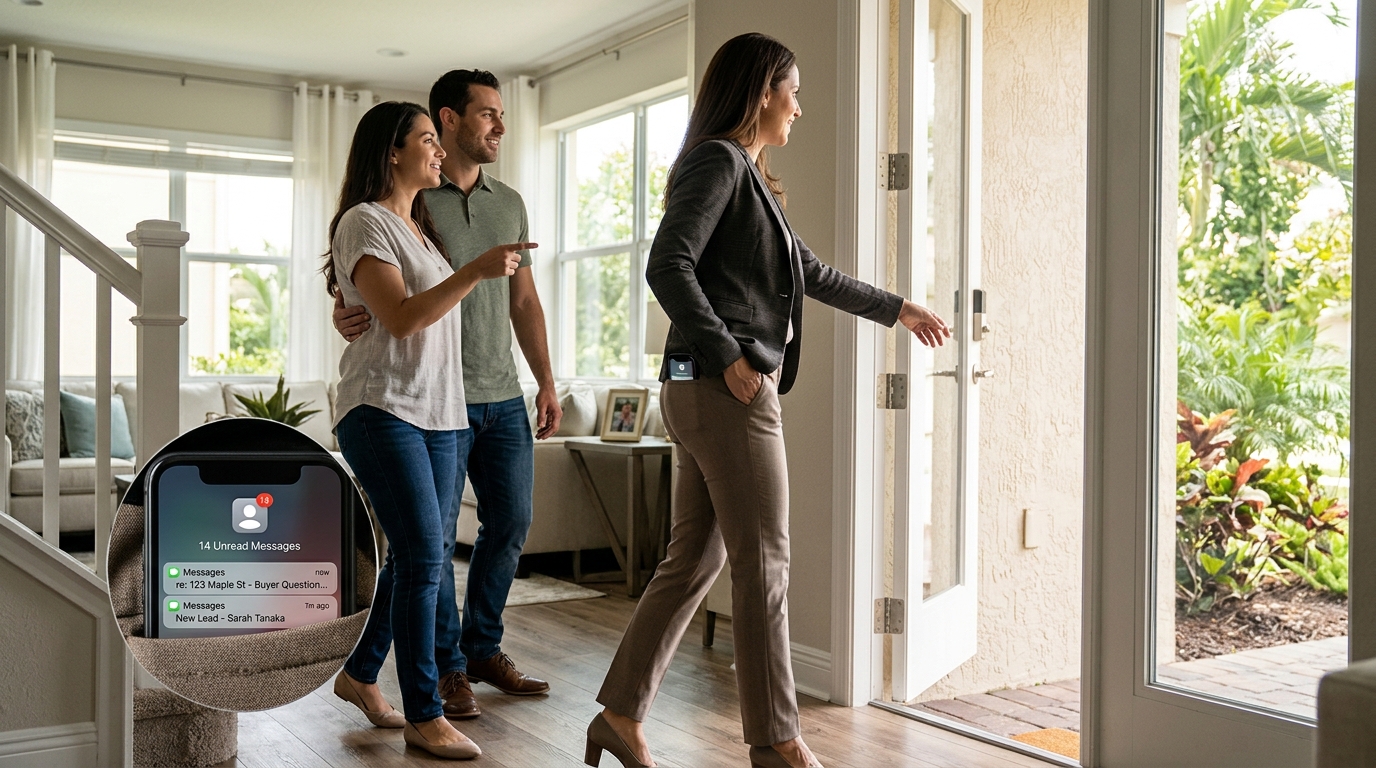
The problem isn't cold leads — it's warm deals going quiet
Most follow-up content online is about lead nurture: what to text a Zillow lead within five minutes, how many times to follow up before giving up, which CRM drip campaign to set up in Follow Up Boss or kvCORE. That advice is fine for the top of the funnel. It does not solve what happens once you have multiple deals in motion.
When you're at a showing from 10am to 4pm — the window where most buyer tours happen — your other clients aren't paused. A seller is waiting on inspection feedback. A buyer under contract needs to know if the lender received their docs. A past client who referred someone to you last week texted to ask if you connected. Every unanswered hour compounds.
The costliest follow-up failure isn't the lead who never heard from you. It's the client under contract who went 48 hours without a word during your busiest stretch — and decided not to refer you.
We call this inter-deal silence. It's distinct from lead response time. Tools like Ylopo AI, Structurely, and CINC handle inbound lead qualification well. ISAs cover initial outreach. But none of them are designed to maintain context-aware communication across several active transactions simultaneously. That's the gap agents at the four-to-eight-deal level feel most.
What Reddy actually sends during your showing hours
Here's a real scenario. You have five active deals. You're physically in a showing from 11am to 1pm. During those two hours, Reddy reads each deal's current stage and sends messages that match what's actually happening — not a generic drip.
| Deal | Stage | What Reddy sends at ~11:30am |
|---|---|---|
| Deal B — Seller (listing) | Appraisal scheduled tomorrow | "Hi Maria, just confirming the appraiser is set for tomorrow at 10am. I'll update you as soon as I have the report." |
| Deal C — Buyer (under contract) | Inspection complete, report received | "Carlos, the inspection report came in. I'm reviewing it now and will send you a summary with next steps this afternoon." |
| Deal D — Past client referral | Referred lead, no contact yet | "Hey Anna, I got your referral — reaching out to them today. Thanks for thinking of me." |
| Deal E — Buyer (pre-approval stage) | Lender docs pending | "Quick update: still waiting on the lender's pre-approval letter. I'll follow up with them if we don't have it by end of day." |
The difference between this and a drip campaign in LionDesk, Wise Agent, or Sierra Interactive is context. A drip fires on a schedule — Day 1, Day 3, Day 7 — regardless of what's happening in the deal. Reddy fires on deal-stage signals: an appraisal date approaching, an inspection report landing, a document still missing. That's why the messages sound right instead of robotic.
Bilingual deals don't pause because you're busy
In South Florida and similar markets, half your deals might run in Spanish. When you're mid-showing, your Spanish-speaking clients experience the same silence — except the gap feels sharper because bilingual agents are harder to find. If you go quiet, they can't easily call another agent who speaks their language for reassurance.
Reddy maintains each client's preferred language automatically. If Maria's deal has been running in Spanish, the appraisal confirmation goes out in Spanish — not a word-for-word translation, but a message that reads naturally to a native speaker.
- English: "Hi Maria, just confirming the appraiser is set for tomorrow at 10am."
- Spanish: "Hola Maria, confirmando que el tasador está programado para mañana a las 10am. Te aviso en cuanto tenga el informe."
This isn't a Google Translate pass. The Spanish message includes the reassurance phrase "te aviso en cuanto tenga el informe" (I'll let you know as soon as I have the report) because that's what a Spanish-speaking client expects — the next step stated up front. English follow-up tends to leave that implicit. These are the kinds of intent-level differences that matter when you're building trust with a first-time buyer who's navigating the process in their second language.
Why drip campaigns don't cover the inter-deal gap
The standard advice for agents who feel follow-up slipping is to set up drip campaigns or action plans in their CRM. That works for one pipeline: nurturing new leads who aren't in a deal yet. It breaks down for active transactions because drip campaigns have no awareness of deal context.
| Capability | Drip campaign (typical CRM) | Reddy |
|---|---|---|
| Trigger type | Calendar-based (Day 1, Day 3, Day 7) | Deal-stage signals (appraisal date, doc received, MLS status change) |
| Message content | Pre-written templates | Generated from deal context and last communication |
| Language handling | English-only or manual translation | Auto-matches client's preferred language |
| Agent control | On/off toggle per sequence | Review, edit, or override any message before or after send |
| Active deal coverage | Not designed for mid-transaction updates | Built for ongoing deal communication |
This isn't an argument against CRMs. Follow Up Boss, kvCORE, and others are good at what they do. But they were built for lead nurture, not for keeping five simultaneous transactions warm while you're physically unavailable. Reddy sits alongside your CRM, not instead of it.
The co-pilot model: you stay in the loop without doing the work
One reason agents resist automation is trust. You've seen what generic AI-generated messages look like — and you don't want that going to your clients. That's a reasonable instinct. Fully autonomous follow-up without agent oversight would be reckless in a transaction where the wrong word can create a contractual misunderstanding.
Reddy uses what we call an agent-in-the-loop design. It drafts and sends context-aware messages during your busy hours, but every message is reviewable. You can check what went out after your showing, adjust the tone for a particular client, or flag a deal where you want to handle communication personally.
- Reddy reads your deal stages and identifies which clients are due for communication.
- It drafts a message matched to the deal context, last touchpoint, and client language.
- The message sends during the showing-hours window when you're unavailable.
- After your showing, you review a summary of what was sent across all deals.
- You override, edit, or add a personal follow-up on any deal that needs your direct touch.
This is the middle ground the industry hasn't built yet. NAR data shows 78% of buyers go with the agent who responds first — but that stat is about new leads. For active deals, the bar is different. Clients under contract don't need speed. They need consistency. They need to feel like their deal isn't lost in your shuffle. That's what this model delivers.
What this looks like across a busy week
Here's a realistic week for an agent with six active deals. Without automated inter-deal follow-up, the gaps in the right column go silent. With Reddy, each one gets a timely, context-appropriate message — in the right language — without you touching your phone.
| Day | You're occupied with | Reddy covers |
|---|---|---|
| Monday 10am–1pm | Buyer showing (3 homes) | Seller client: appraisal confirmation. Referral lead: intro message. |
| Tuesday 11am–3pm | Listing presentation + photos | Buyer under contract: lender doc status. Past client: thank-you for referral. |
| Wednesday 9am–12pm | Inspection walkthrough | Seller client: showing feedback summary. New lead: follow-up #2 in Spanish. |
| Thursday 1pm–4pm | Closing at title company | Buyer in pre-approval: rate lock reminder. Listing client: open house prep update. |
| Friday 10am–2pm | Back-to-back showings | All active deals: end-of-week status touchpoints in each client's language. |
None of these messages are complicated. That's the point. They're the simple, consistent updates that you'd absolutely send if you had five free minutes between appointments. You just don't have those five minutes — at least not reliably, not every day, not across six deals at once.
The follow-up that kills referrals isn't the message you forgot to send to a stranger. It's the update you owed a client who already trusted you — and heard nothing for two days.