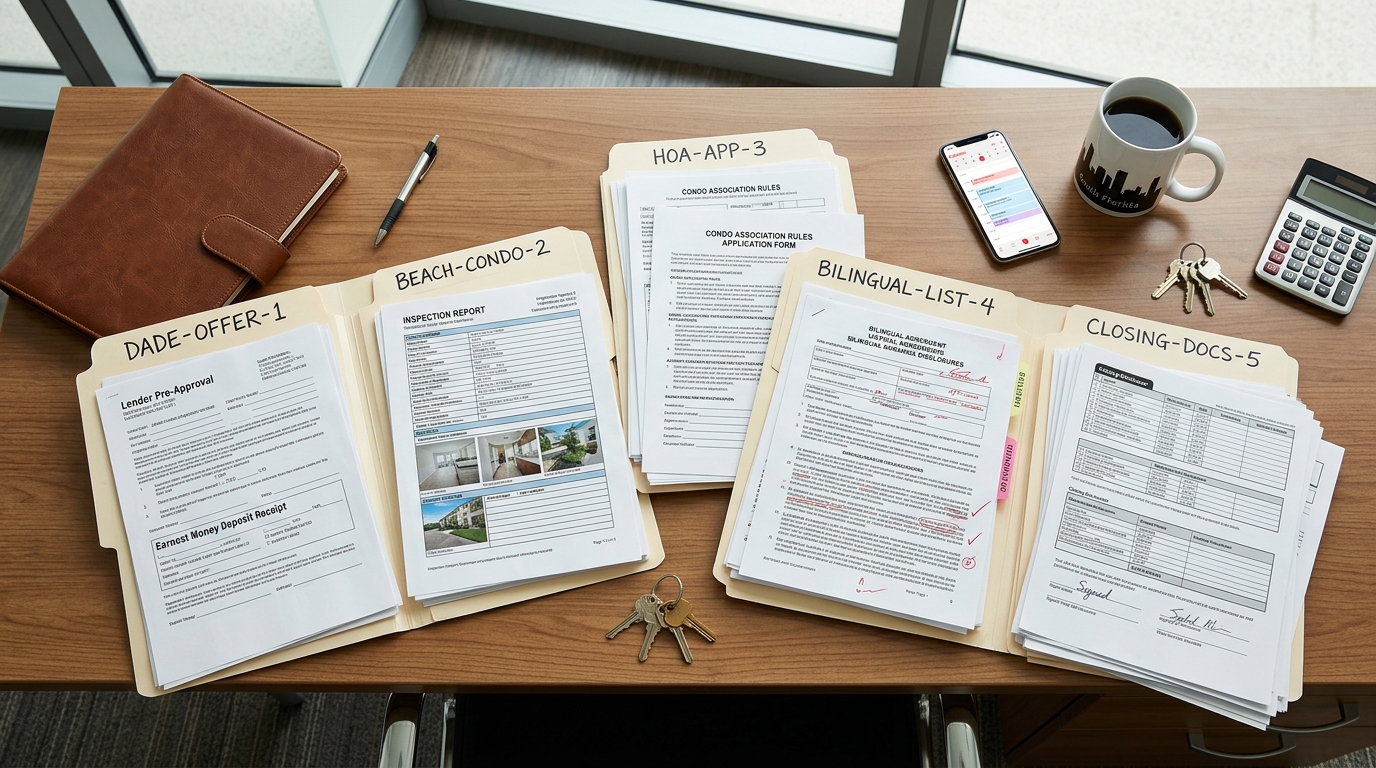

Why Better Tasks Don't Fix the Problem
Most agents approach admin overload the same way: they improve the pieces. Better listing templates. Faster document prep. Tighter checklists. A new tool for e-signatures. And each improvement is real — the task itself gets faster, cleaner, more reliable.
But the deal still stalls. The closing still gets pushed. The client still calls asking why nobody followed up.
Here's why. According to Asana's Anatomy of Work research, knowledge workers spend roughly 60% of their time on 'work about work' — coordination, status checks, searching for information, figuring out what's next. McKinsey's productivity research pins 28% of the average workweek on email alone, most of which is spent not doing work but figuring out where work stands. In a real estate transaction with 375+ interdependent tasks spread across agents, TCs, lenders, title companies, and attorneys, the math gets brutal fast.
The bottleneck is never inside the task. It's in the gap between one task ending and the next one starting — where ownership is ambiguous, status is invisible, and nothing moves until someone manually checks.
Tallyfy's workflow research found that 43% of operations leaders identify execution handoffs — not individual task failure — as their biggest workflow breakdown. In real estate specifically, the top five causes of missed deadlines are all handoff-adjacent: lender document delays not caught in time (34%), TC overload across simultaneous transactions (28%), deadline date errors at file open (18%), communication gaps between parties (12%), and documents uploaded to the wrong location (8%). Not one of those is a 'bad task' problem. Every single one is a gap between steps or between people.
The Three Types of Handoffs That Break Your Admin
Not all handoff failures are the same. We've found that agents who lump them together end up applying the wrong fix — adding more communication when the problem is a missing trigger, or adding more tools when the problem is ambiguous ownership. Here's a taxonomy you can audit against your own workflow.
| Handoff Type | What It Looks Like | Common Failure Mode |
|---|---|---|
| Person-to-Person | Agent → TC, TC → Lender, Agent → Attorney | Bystander effect: both parties assume the other is handling the next step |
| System-to-System | CRM → Transaction platform, e-sign → document storage | Data lands in one system but doesn't trigger action in the next |
| Step-to-Step | Document drafted → Document sent, File received → File acknowledged | Task completes internally but the output never moves forward |
Person-to-person handoffs are the ones agents think about most, because they involve people. But system-to-system and step-to-step failures are often more damaging precisely because they're invisible. A disclosure drafted in Dotloop or SkySlope that never gets sent isn't a people failure — it's a step-to-step gap. The work happened. The output didn't move.
Missing Triggers vs. Ambiguous Ownership: Two Failures That Need Different Fixes
Once you know which type of handoff broke, you need to identify why it broke. We see two root causes that get lumped together constantly but require fundamentally different responses.
A missing trigger means nobody told the next person to start. The lender finished their review but no notification went to the TC. The inspection report arrived in email but nobody flagged it for the agent. The previous step completed — the next step just never got a starting signal.
Ambiguous ownership means two people both thought the other was handling it — or neither realized it was theirs. The attorney assumes the agent will schedule the walkthrough. The agent assumes the TC handles it. Three days pass. The walkthrough doesn't get scheduled. PMI research on project failure consistently identifies this pattern: unclear responsibility during transitions is a leading contributor to missed deadlines, even on projects where the individual work is high quality.
| Root Cause | Symptom | Fix Category |
|---|---|---|
| Missing trigger | Next step never starts despite previous step completing | Automation or structured notification — build a trigger into the workflow |
| Ambiguous ownership | Step eventually starts late because two people assumed the other had it | Explicit ownership transfer — name the person and the moment responsibility shifts |
This distinction matters because agents often respond to both problems the same way: they add more communication. A Slack message. A status email. A morning standup. But as the Tallyfy research shows, adding more communication channels without fixing the structural gap just scatters task status across more locations. Information that exists in five places effectively exists in zero.
If the root cause is a missing trigger, the fix is mechanical — you need a system or protocol that automatically signals the next step when the previous one completes. If the root cause is ambiguous ownership, the fix is structural — you need explicit handoff moments where one person confirms they're picking up and the other confirms they're letting go. Like a relay race: you don't just throw the baton in the general direction of the next runner. There's a transfer zone, a verbal signal, and a physical exchange.
The Handoff Audit: Trace Your Last Three Stalled Deals
Here's a practical method we've walked agents through that takes about 30 minutes and reveals more about your operational gaps than any tool demo ever will.
- Pick your last three deals that experienced a delay, a missed deadline, or a 'someone dropped the ball' moment.
- For each deal, identify the exact moment something stopped moving. Not the task that was late — the gap before it. What was the last completed step, and what should have happened next?
- Classify the gap: Was it person-to-person, system-to-system, or step-to-step?
- Identify the root cause: Was there a missing trigger (nobody signaled the next step) or ambiguous ownership (unclear who was supposed to act)?
- Look for patterns across all three deals. If the same type of handoff or the same root cause shows up in two or three of them, that's your structural weak point.
This is the diagnostic step that's completely missing from the top-ranking advice on real estate workflow improvement. Existing content jumps straight to 'automate your transaction coordination' or 'use a better platform' without teaching you how to figure out which specific handoff is actually breaking. You can't fix what you haven't traced — and the pattern is almost never where you think it is. We've seen agents convinced their document prep was the bottleneck, only to discover during an audit that docs were being prepared on time every single transaction. The failure was always downstream: a step-to-step gap where a prepared document sat unsent, or a person-to-person gap where the lender never got a nudge to confirm receipt.
Why the Same Gap Costs You Two Days in Week One but Kills the Deal in Week Five
Not all handoff failures are equally dangerous. The same type of gap — say, a 48-hour delay in confirming document receipt — creates dramatically different consequences depending on when in the transaction it happens.
Early in a transaction (contract intake, initial disclosures), a two-day handoff gap creates a two-day delay. Annoying, but recoverable. There's scheduling slack. Deadlines are weeks away. You compensate without the client ever knowing.
In weeks three and four (inspections, appraisal, lender conditions), that same two-day gap starts compressing downstream deadlines. Now the appraiser's availability shrinks. The lender's underwriting window gets tighter. You're not just two days late on one step — you're squeezing every step that follows.
In the final week before closing, the same gap is catastrophic. TRID rules — the TILA-RESPA Integrated Disclosure rule enforced by the CFPB — require that the Closing Disclosure be delivered to the buyer at least three business days before closing. A two-day handoff gap at this stage doesn't just delay — it can force a closing date change, which triggers a cascade: rate lock extensions, moving schedule conflicts, seller frustration, and potential E&O exposure if the delay stems from agent negligence.
| Transaction Stage | Handoff Gap Duration | Consequence |
|---|---|---|
| Week 1–2 (Contract intake) | 48 hours | Minor delay, recoverable without client impact |
| Week 3–4 (Inspections, appraisal) | 48 hours | Downstream compression — tighter windows on every subsequent step |
| Week 5+ (Pre-closing) | 48 hours | Potential closing date change, TRID violation risk, E&O exposure |
This is the 1:10:100 rule in action: preventing a handoff error costs almost nothing (a confirmation step, an automated trigger). Catching it mid-transaction costs real coordination time. Leaving it uncaught until pre-closing costs rescheduled closings, strained client relationships, and in some cases, legal exposure.
The Bystander Effect Is Killing Your Team's Handoffs
There's a well-documented psychological pattern that shows up in real estate teams and nobody talks about it in operational terms: the bystander effect. In emergency response research, the more people present during an incident, the less likely any single person is to act — everyone assumes someone else will step in.
The same dynamic plays out in real estate transactions, just slower and quieter. The lender thinks the attorney has everything needed for closing. The attorney is waiting on the lender to clear conditions. The agent is coordinating but doesn't have visibility into what's actually missing versus what's just slow. Three parties. Zero confirmed owners of the gap between them.
This is the structural pattern behind the finding that document flow breaks approximately three weeks before closing. It's not that anyone is incompetent — it's that everyone is competent at their piece and assumes someone else owns the connective tissue between pieces.
Task assignment is not the same as ownership transfer. Assigning a task says 'this is yours.' An ownership transfer says 'I am done, you are starting, and we both acknowledge the handoff happened.' One is a label. The other is a protocol.
The fix isn't more communication — it's explicit transfer moments. When we've worked with agents to redesign their workflows, the single highest-impact change is almost always this: replace implicit handoffs ('I sent it, so it's their problem now') with confirmed transfers ('I sent it, they acknowledged receipt, and the next step is now active'). We've written more about the broader challenge of figuring out which tasks actually need your involvement and which ones don't in our piece on what actually requires you when delegating admin — because the handoff problem gets worse when agents hold onto tasks they shouldn't own in the first place.
Confirmation Loops: The Missing Layer Between 'Sent' and 'Done'
Here's a scenario that plays out in nearly every transaction we've observed: an agent sends a document to the lender. In their mind, that task is done. It's off their plate. Checked off the list. But 'sent' is not 'received.' And 'received' is not 'opened.' And 'opened' is not 'acknowledged as complete and ready for the next step.'
The gap between sent and confirmed is where the most damaging handoff failures live, because they're invisible for the longest time. A missing trigger announces itself relatively quickly — nothing happens, someone notices. But a broken confirmation loop can hide for days. The document sits in a spam folder. The lender downloaded it but flagged a missing page and never told anyone. The title company received the file but their system didn't match it to the right transaction.
- Sent ≠ Received (email deliverability, spam filters, wrong address)
- Received ≠ Opened (file sits in an inbox or download queue)
- Opened ≠ Reviewed (the person saw it but hasn't processed it)
- Reviewed ≠ Accepted (the document may have issues that require revision)
- Accepted ≠ Next Step Triggered (even an accepted document doesn't automatically start what comes after)
Each of those gaps is a potential stall point. And in a transaction with dozens of documents moving between five or more parties, the probability that at least one confirmation loop breaks is close to 100%.
This is also where admin creep sneaks into your workflow. Every unconfirmed handoff eventually requires a manual follow-up — a check-in email, a phone call, a text. Those micro-tasks don't show up on any checklist, but they accumulate. We explored how this kind of invisible task accumulation quietly consumes agent hours in our breakdown of how admin creep stalls agent growth.
What an Actual Handoff-Proof Workflow Looks Like
You don't need to overhaul your entire operation. You need to add structure to the gaps between the tasks you're already doing. Here's what a handoff-aware workflow looks like in practice, applied to a common sequence: lender conditions clearance in the final two weeks before closing.
- Lender issues conditions list → TC receives and confirms receipt to agent within 2 hours (person-to-person handoff with explicit confirmation)
- TC reviews conditions, identifies which require agent action vs. borrower action vs. third-party action → TC assigns each condition with a named owner and a due date (ambiguous ownership eliminated)
- Agent gathers their assigned documents and uploads to the lender portal → Agent marks upload complete AND the system notifies TC that upload occurred (step-to-step handoff with automated trigger)
- TC confirms with lender that uploaded documents were received and are under review — not just sent, but confirmed in lender's queue (confirmation loop closed)
- Lender clears each condition → TC receives clearance notification and triggers next step: ordering final Closing Disclosure (system-to-system handoff with trigger)
- Closing Disclosure delivered to buyer → 3-business-day TRID clock starts with a calendar reminder to all parties (regulatory handoff with explicit countdown)
Notice what's different from a standard checklist. Every step has a named owner. Every transition has a trigger. Every critical document has a confirmation loop. The work inside each step hasn't changed — it's the same documents, the same people, the same tools. What changed is that the gaps between steps now have structure instead of relying on someone remembering to check.
Tools like ListedKit and Tallyfy can automate some of these triggers. Platforms like Dotloop and SkySlope provide some system-to-system connectivity. But the structural thinking — mapping which handoffs exist, who owns each transition, and where confirmation loops are required — has to happen before you pick any tool. Otherwise you're automating a broken handoff, which just makes it break faster.
Stop Fixing Tasks. Start Fixing Transitions.
The real estate industry has spent years getting better at individual tasks. Document prep is faster. E-signatures are mainstream. Checklists are everywhere. And yet deals still stall, deadlines still get missed, and agents still spend hours every week on status checks and follow-ups that shouldn't be necessary.
That's because we've been optimizing the wrong layer. The tasks were never the problem. The transitions between tasks — where ownership shifts, where status goes dark, where nobody confirms the next step started — that's where your system breaks.
- Map your handoffs: person-to-person, system-to-system, step-to-step
- Diagnose the root cause: missing trigger or ambiguous ownership
- Triage by transaction stage: prioritize handoffs closest to closing
- Replace implicit handoffs with explicit ownership transfers
- Close confirmation loops on every high-stakes document
- Audit against your last three stalled deals to find your specific pattern
Your admin system doesn't need more tasks done better. It needs the spaces between tasks to stop being dead zones where deals go silent.
This is the kind of operational gap that's hard to see from inside your own workflow — which is exactly why a structured diagnostic from someone who's mapped these patterns across dozens of agent workflows can surface the specific handoff that's costing you the most time and the most deals.