
Why the "busy but unproductive" feeling won't go away on its own
Most agents respond to the admin burden with one of two moves: they try to power through everything faster, or they throw a tool at the whole problem at once. Neither works, because neither addresses triage.
Think of it like a slow leak in ten different tires. Patching all ten at once sounds logical, but you only have time and budget to patch three before the car is on blocks. The smart move is figuring out which tires are losing air fastest. Admin tasks work the same way.
The ranking below isn't based on how annoying each task feels. It's based on a combination of three factors: average time per occurrence, weekly frequency for an active agent doing 15–25 transactions a year, and whether the task tends to land during peak selling hours — roughly 9 a.m. to 1 p.m. and 4 p.m. to 7 p.m., when prospects actually pick up the phone. A task that takes ten minutes at 10 a.m. on a Tuesday costs you more than one that takes twenty minutes at 9 p.m. on a Sunday. We've broken down where real estate agents' hours actually go in a separate deep-dive if you want the full picture.
1. Transaction paperwork assembly and chasing signatures
Estimated cost: 4–7 hours per week for an active agent.
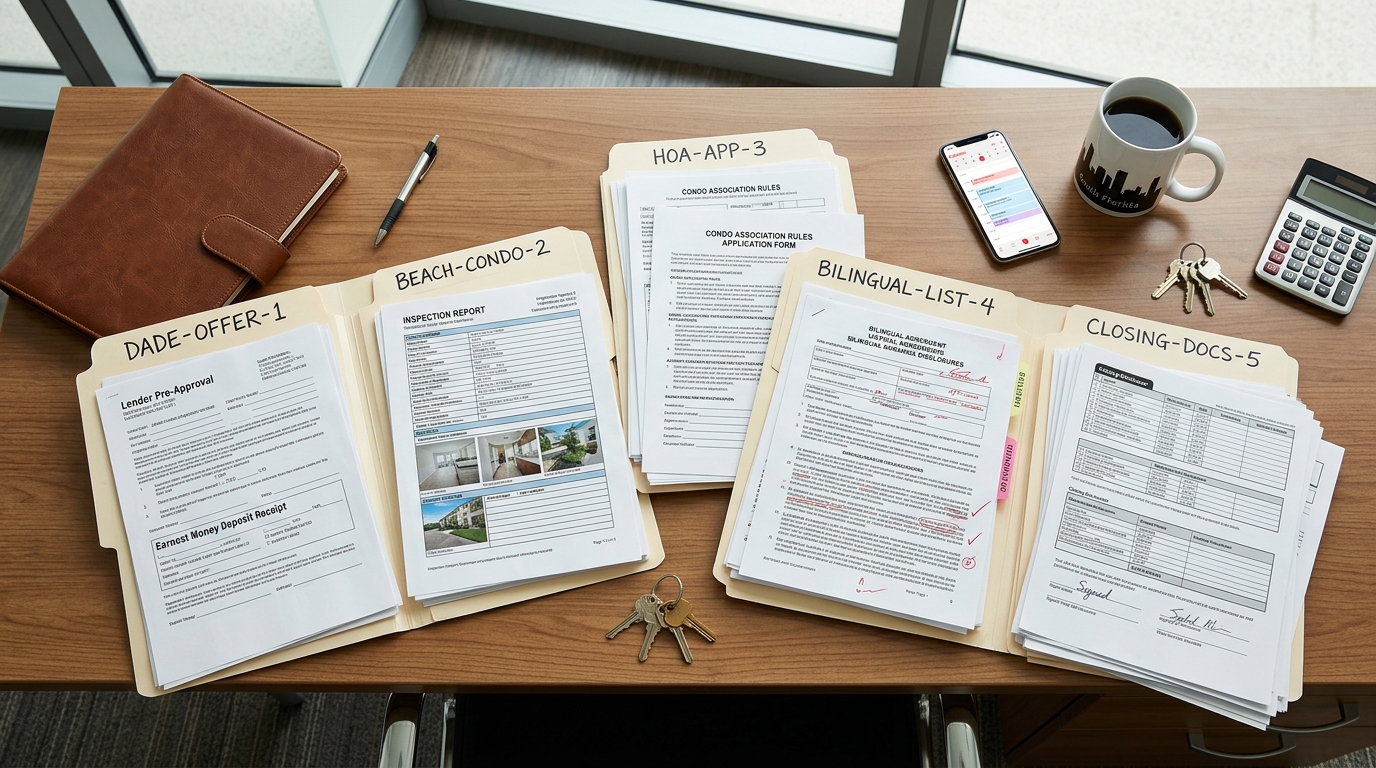
This is the undisputed heavyweight. Every deal has its own document stack — purchase agreements, disclosures, addenda, repair requests — and each one needs signatures from the right people in the right order. The paperwork itself is bad enough, but the real time sink is the chasing: following up with buyers, sellers, co-agents, title companies, and lenders who haven't signed yet.
The compounding factor here is interruption. You rarely sit down and do all your paperwork in one clean block. Instead, you check a signature status mid-showing, text a reminder between appointments, and log back in after dinner to see if the lender finally countersigned. Each of those micro-interruptions fragments your selling focus. If you handle paperwork for different deal types, you know the document list changes every time — we put together a paperwork checklist by deal type that helps reduce the guesswork, but the core time cost remains unless the assembly and chasing steps are handled for you.
2. CRM data entry and contact updates
Estimated cost: 3–5 hours per week.
Every open house sign-in sheet, every new lead from a portal, every business card from a networking lunch — they all need to land in your CRM with the right tags, notes, and next steps. Most agents know this matters, and most agents are also three weeks behind on it at any given time.
The hidden cost isn't just the data entry itself. It's the downstream failure: when contacts aren't updated, your follow-up sequences target the wrong people or miss warm leads entirely. So the four hours you didn't spend on CRM hygiene this week turn into a cold lead next month that should have been a listing appointment. The compounding is silent, which is exactly why this ranks so high.
3. Appointment scheduling and rescheduling
Estimated cost: 2–4 hours per week.
This one surprises people because each individual scheduling exchange feels quick — a couple of texts, maybe a phone call. But count how many you do in a week. Showings, listing presentations, inspections, appraisals, photographer visits, staging walkthroughs, buyer consultations. Each one involves at least two parties with conflicting calendars.
The compounding factor is rescheduling. Roughly one in three appointments shifts at least once, and each shift restarts the coordination cycle. If you're the one doing the back-and-forth — rather than having it handled by a system or a person — you're burning prime selling hours on logistics that generate zero revenue.
4. Email triage and response
Estimated cost: 2–3 hours per week (often spread across the entire day).
Agents who check email on their phone between every appointment know the feeling: you open the inbox intending to answer one thing, and twenty minutes later you've replied to six messages, none of which were urgent. The real problem is that email doesn't sort itself by importance. A lender asking for a corrected document sits next to a newsletter you forgot to unsubscribe from, and your brain has to evaluate each one before deciding what to do.
The compounding factor is that email triage almost always happens during selling hours. You check it in the car before a showing. You check it at lunch. You check it while waiting for a client to arrive. Every check is a small withdrawal from the attention you need for prospect conversations and negotiations.
5. Listing input and MLS updates
Estimated cost: 1.5–3 hours per week during active listing periods.
Entering a new listing into MLS is tedious but at least it's a defined task. The ongoing updates are worse: price changes, status updates, open house announcements, photo swaps, remarks revisions. Each one requires logging in, navigating the interface, double-checking the data, and hitting publish. It doesn't take long individually, but during a busy listing month it adds up.
The hidden cost here is accuracy pressure. A typo in square footage or a wrong status can create compliance headaches or mislead buyers. So agents slow down and triple-check — which is the right thing to do, but it makes a fifteen-minute task take thirty.
6. Social media content creation and posting
Estimated cost: 2–4 hours per week (higher if you also create video).
Marketing isn't optional for most agents. But the time it takes to shoot a photo, write a caption, pick the right hashtags, post across platforms, and respond to comments is almost always underestimated. Agents often batch this on weekends, which means it's eating into rest time rather than admin time — and that matters too.
The compounding factor is inconsistency. If you miss a week because a deal got busy, your engagement drops, and the effort you put in the previous week partially evaporates. It's a treadmill that punishes you for stepping off, which makes it one of the more psychologically draining admin tasks even though its raw hour count isn't the highest on this list.
7. Lead follow-up that falls through the cracks
Estimated cost: Hard to measure directly, but the opportunity cost is enormous.
This isn't a task in the traditional sense — it's the absence of a task. When an agent is buried in admin, the first thing that slips is follow-up with leads who aren't yet hot. The showing request gets answered. The signed offer gets handled. But the person who asked a question at an open house three days ago? They go quiet, and so do you.
We rank this at number seven because the time you'd spend on follow-up isn't huge — maybe 30–60 minutes a day if you had a clean system. The problem is that the admin tasks above this on the list crowd it out entirely. So the cost isn't measured in hours spent. It's measured in conversations that never happened and appointments that were never set.
8. Vendor and service provider coordination
Estimated cost: 1–2 hours per week.
Photographers, stagers, inspectors, handymen, cleaners, sign installers — every listing and closing involves a small army of service providers who need to be booked, confirmed, and occasionally rebooked. The coordination itself is simple, but it fragments your day the same way scheduling does.
The compounding factor is that vendor coordination often comes with small fires: the photographer can't make the original time, the cleaner needs access instructions, the inspector found something that changes the timeline. Each fire is small, but each one pulls you out of whatever selling activity you were doing or about to start.
9. Commission tracking and invoice management
Estimated cost: 1–2 hours per week, spiking around closings.
Most agents don't think of this as a major time drain because it clusters around closings rather than spreading across every day. But when you add up the time spent reviewing commission statements, reconciling splits, chasing referral fees, submitting invoices to your brokerage, and tracking expenses for taxes — it's more than you'd guess.
The hidden cost is context switching. Commission work requires a financial mindset — numbers, calculations, accuracy — that's completely different from the relationship-driven mindset of selling. Jumping between the two is cognitively expensive, and it usually happens at the worst time: right when you should be celebrating a close and moving on to the next opportunity.
10. Compliance documentation and file audits
Estimated cost: 30–90 minutes per week, depending on brokerage requirements.
This lands at the bottom of the list not because it's unimportant — it absolutely is — but because most agents have been forced into decent compliance habits by their brokerages already. The time cost is real but relatively contained.
Where it compounds is in the mental overhead. Knowing that your files need to be audit-ready adds a background hum of anxiety that makes every other admin task feel heavier. Agents who haven't built a clean system for compliance documentation spend more emotional energy worrying about it than they spend actually doing it.
What to do with this list (besides feel overwhelmed)
If you read all ten and felt your chest tighten, that's normal. But the whole point of ranking them is to free you from the trap of trying to fix everything at once.
Here's the practical move: pick the top two or three tasks on this list that hit you hardest. Ignore the rest for now. For each one, ask a simple question — can I eliminate it, delegate it, or at least batch it into a non-selling time block?
Elimination is rare. Most of these tasks actually need to happen. But delegation and batching are real options. Some agents hand off paperwork chasing to a transaction coordinator. Others use scheduling tools to eliminate the back-and-forth. The key is matching the fix to the specific task rather than buying a broad productivity tool and hoping it covers everything.
If you're not sure where your hours are actually going right now, start with a simple tracking exercise. Even one week of honest time logging will show you which of these ten tasks is doing the most damage to your specific workflow. We mapped out what a typical agent's 50-hour week actually looks like if you want a starting framework.
The agents who make real progress on admin load aren't the ones who work harder or adopt more tools. They're the ones who finally see the ranked list clearly, pick the top offenders, and fix those first. Everything else can wait.