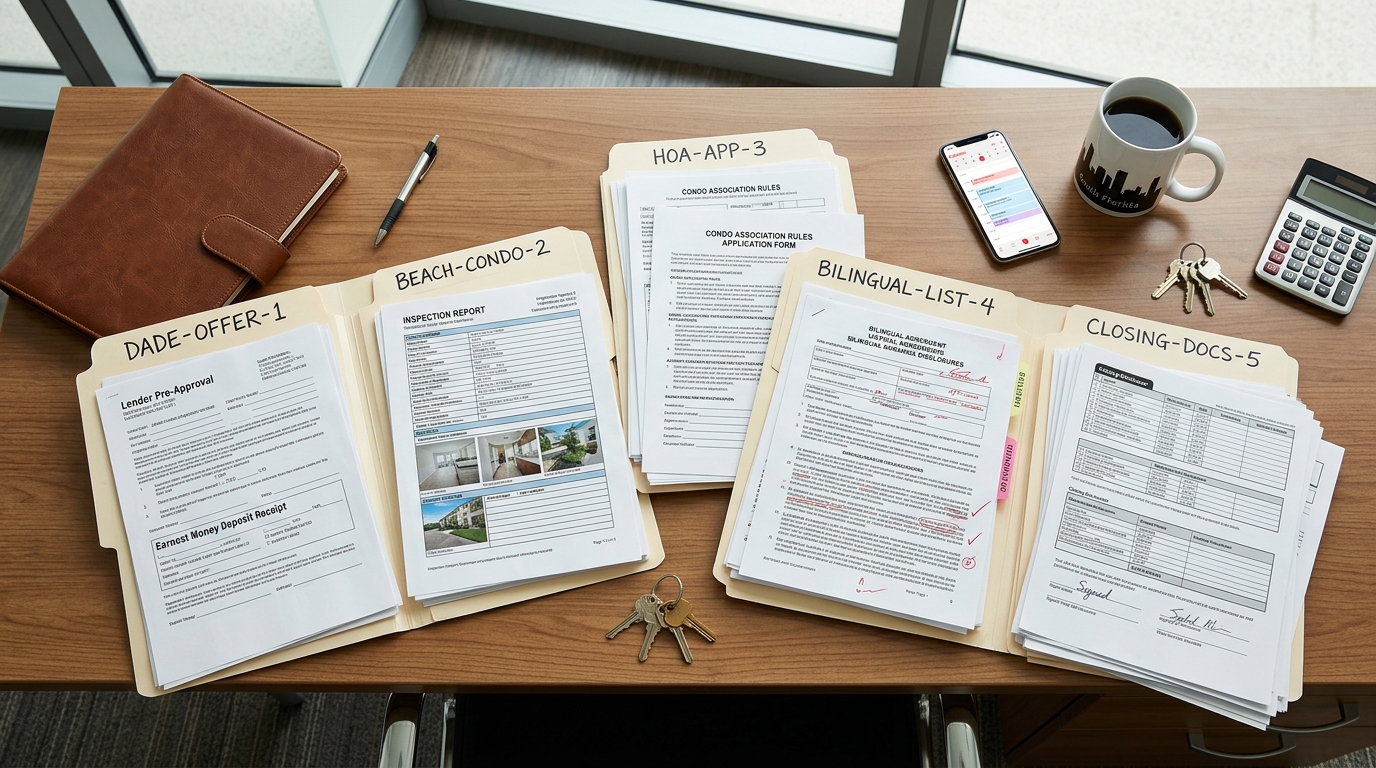

Monday: Onboarding Three Deals in Under an Hour
Onboarding didn't start with a CRM migration or a settings wizard. In this example it runs over WhatsApp, step by step.
- Open your WhatsApp chat with Reddy.
- Forward the executed purchase agreement for each deal — one message per deal.
- Reddy replies with a deal confirmation prompt. Reply with the deal name (e.g., '742 Elm – Gutierrez seller') and confirm.
- Tell Reddy each contact's language preference. For the mixed-language household, that meant one spouse in English and the other in Spanish.
- Forward any additional documents already in hand — disclosures, addenda, lender conditions. Reddy adds them to the deal file automatically.
Within minutes of receiving each file, Reddy generated a deal checklist. It identified missing documents — the English-only buyer was missing a signed inspection contingency addendum, the Spanish-dominant seller's file lacked an updated mortgage payoff letter, and the mixed-language family's deal was missing a lead-based paint disclosure. None of this required the agent to build a checklist from scratch or cross-reference a spreadsheet.
The language-preference step is where bilingual operations diverge from English-only onboarding: you're not just tagging a deal, you're tagging each person in the deal. For the mixed-language household, status updates to that family would go out in both languages within the same thread.
In this example, onboarding all three deals takes roughly 40 minutes, and most of that time goes to locating the contracts on the phone, not interacting with Reddy. If you're wondering how that compares to a typical setup, we covered the general first-week onboarding flow in our breakdown of what Reddy handles in week one.
Reddy First Week for a Bilingual Real Estate Agent: Tuesday–Wednesday in the Showing-Hours Dead Zone
If you run showings between 2 and 6 PM, you already know the problem. Clients text. Lenders need documents. Title companies send condition lists. And you're standing in a kitchen explaining countertop materials while your phone buzzes in your pocket. By the time you sit down at 7 PM, you've got a backlog — and half of it needs to go out in Spanish.
This is where Reddy produced its most visible first-week results. On Tuesday afternoon, while the agent was running three back-to-back showings, the system sent three messages. Composing and sending them by hand would take roughly 35 minutes — an estimate for this example, not a measured result.
| Deal | Message Sent | Language | Agent Action Required |
|---|---|---|---|
| Spanish-dominant seller | Lender condition reminder: updated payoff letter needed by Thursday | Spanish | None — routine reminder |
| English-only buyer | Inspection prep checklist and timeline confirmation | English | None — routine reminder |
| Mixed-language family | Status update on appraisal scheduling | English + Spanish (same thread) | None — informational update |
The bilingual status update to the mixed-language household is worth pausing on. Normally, this is where bilingual relay work hits hardest. You draft the English version, then rewrite it in Spanish — not translate word-for-word, but rewrite for meaning and tone. Done by hand, an update like this can take 10–15 minutes — again an illustration, not a measurement. Reddy composed both versions from the same deal context and delivered them in one thread.
Wednesday looked similar. A Spanish-language reminder went to the seller's family about a disclosure signature deadline. An English follow-up nudged the buyer's lender on a missing condition. The agent checked the message log from the car between appointments and didn't need to intervene on any of them.
Thursday: When the Agent Needs to Step In
Not everything should go out without a human eye on it. Thursday's queue included a repair negotiation update for the mixed-language family — the seller had countered on a roof repair credit, and the message touched price. Reddy flagged it for review instead of sending automatically.
Anything that involves price, contract terms, or negotiation strategy queues for agent review. Reddy drafts it; you approve or edit before it sends. That's the agent-in-the-loop step that makes week one feel trustworthy rather than nerve-wracking.
The agent opened the queued update, with the English and Spanish versions side by side, and approved or edited each one. The English version was approved as-is — clear, accurate, matched the counter terms. The Spanish version needed a tone adjustment. The original phrasing was technically correct but read too formal for the family's communication style. The agent softened two sentences and approved. Both messages went out within four minutes.
Without Reddy, this update would have sat in the agent's mental to-do list until after dinner. That's not laziness — it's the reality of composing a sensitive bilingual message while also running a business. The 'I'll get to it tonight' pile is where client trust quietly erodes.
Friday: Where the Hours Came Back
By Friday, the agent estimated what didn't happen manually this week. Nothing here is a measurement: the ranges below are illustrative estimates for this example week with three concurrent bilingual deals, and your numbers will differ.
| Task Category | Estimated Manual Time | Reddy Handled | Agent Time Spent |
|---|---|---|---|
| Bilingual relay work (same update, two languages) | 2–3 hours | Yes — both versions composed from deal context | ~15 min reviewing flagged messages |
| Document reminders and missing-item follow-ups | 1–1.5 hours | Yes — reminders sent per checklist deadlines | ~10 min checking logs |
| Showing-hours client updates (2–6 PM dead zone) | 45–90 min | Yes — queued and sent on schedule | 0 min during showings |
| Repair negotiation update (sensitive, price-related) | 30–45 min composing + translating | Drafted, queued for review | ~10 min editing and approving |
The biggest single recovery was bilingual relay work. Composing the same status update twice — once in English, once in Spanish, each adjusted for tone and context — is the task that eats bilingual agents alive. It's not hard work. It's just work that doubles every time you have a mixed-language deal, and it compounds when you're running three files at once.
Total estimated time recovered in this example: 4–6 hours across the week. Most of that time came back in the evenings — the hours that would have gone to catching up on messages that should have gone out at 3 PM.
Honest Friction: What Didn't Go Smoothly in Week One
This wouldn't be useful if we skipped the rough spots. Week one had friction, and pretending otherwise would set the wrong expectations.
- Language mismatch on one message: Reddy defaulted to English for a Spanish-preferred contact because the preference hadn't been set during onboarding — the agent had missed tagging one family member. Fixed in two taps, didn't recur.
- Reminder timing too early: A lender condition reminder went out three days before the actual deadline, which confused the seller's family. The agent asked Reddy to send that kind of reminder 48 hours before a deadline instead of 72, and later reminders followed the new timing.
- Insufficient deal context on a title issue: Reddy didn't have enough background on a title lien question to draft a useful client update, so it queued a placeholder that read: 'We're reviewing a title item and will share details soon.' The agent replaced it with a specific message: 'The title search flagged a $2,400 mechanic's lien from a 2019 roof repair. We've contacted the title company to confirm whether it was satisfied at closing on the prior sale. I'll have an update by Thursday.' That rewrite took about five minutes.
- Over-formal Spanish tone in two early messages: The system's initial Spanish drafts used phrasing like 'Le informamos que la tasación ha sido programada para el día jueves' — correct, but stiff for the family's conversational style. The agent softened it to 'Quería avisarles que la tasación ya quedó para el jueves' — closer to how she'd actually text the family. After editing those first two drafts, subsequent messages better matched her tone.
Every one of these friction points was a week-one issue. The language mismatch disappeared once contacts were tagged correctly. The tone calibration improved after a few edits. The reminder timing was a one-time settings change. By week two in this scenario, the agent intervenes on about half as many messages as in week one.
Week one is calibration. You're teaching the system your deals, your clients, and your voice. The friction is real but front-loaded — and it's still less time than doing everything manually.
Is It Worth It With Just a Few Deals?
A common question from bilingual agents evaluating Reddy: does this only pay off at high volume? The example agent in this walkthrough was running three deals — not ten, not twenty. Three. The estimated recovery still came to 4–6 hours per week because bilingual relay work scales with language complexity, not just deal count.
One mixed-language household generates as much communication overhead as two English-only deals. If even one of your active files involves switching between languages — drafting in English, rewriting in Spanish, confirming meaning with both parties — that single deal can account for 2–3 hours of additional weekly communication work. That figure is an estimate for this example, not a measured result.
If you're still deciding whether the timing is right, our guide on when to add Reddy walks through the deal-count and workflow signals that suggest you're ready. But if you're running bilingual deals right now and composing the same update in two languages every evening, this example suggests the first week can recover more hours than it costs in onboarding and calibration.