Why English Follow-Up Templates Break in Spanish
The standard advice — send a thank-you email the morning after the showing, then a market-update email three days later — assumes your buyer checks email regularly and expects a professional, slightly distant tone. Spanish-speaking buyers, especially first-generation immigrants and buyers whose primary digital channel is WhatsApp, operate on a completely different rhythm.
- According to Statista's 2023 "Messaging Apps in Latin America" report, over 90% of internet users in the region use WhatsApp as their primary messaging channel. That habit doesn't disappear when someone moves to Miami or Houston.
- An email that arrives 18 hours after a showing already feels late. A WhatsApp message that arrives within 2–4 hours matches the conversational cadence the client is already using with you.
- Popular English-language coaching programs — such as Tom Ferry's "Buyer Conversion" modules and Keller Williams' BOLD program (specifically the prospecting and objection-handling sessions) — emphasize urgency phrases like 'Are you ready to write an offer?' within 24 hours. For many Hispanic buyers, that window is when they're consulting with family, not making a decision. You can review the BOLD curriculum overview on Keller Williams' training portal and Tom Ferry's published scripts on tomferry.com to see this framing in context.
Calibrating Tone: Tú vs. Usted and the Formality Trap
In English, 'Hi Maria, thanks for coming out today!' works for almost any buyer. In Spanish, the equivalent decision — tú or usted, warm or formal — carries real social weight. Get it wrong and your follow-up feels either stiff or presumptuous.
| Buyer Profile | Register | Opening Example | Avoid | Why This Register Works |
|---|---|---|---|---|
| Younger, U.S.-raised bilingual | Tú, warm-professional | "¡Hola María! Qué bueno verte hoy — quería mandarte las fotos que te prometí." | "Estimado cliente" — reads like a bank letter | U.S.-raised bilinguals typically default to tú in everyday professional contexts. Switching to usted can feel awkward or artificially distant — like being called 'sir' by someone your own age. Matching their casual register signals that you see them as a peer, not a transaction. |
| Mid-career, immigrated 10+ years ago | Usted initially, shift to tú if rapport is strong | "Hola Sra. López, fue un gusto acompañarla hoy. Le mando unas fotos de la cocina que le gustó." | Jumping to tú before they signal comfort | Many buyers who immigrated from Mexico, Colombia, or Central America carry the usted-default they learned at home, especially in professional or financial contexts. Starting with usted shows respect for that norm. If they begin using tú with you — often a sign the relationship has warmed — you can mirror the shift naturally. |
| Recent immigrant, formal expectations | Usted throughout unless they switch | "Buenas tardes, Sr. Ramírez. Quería darle seguimiento a la visita de hoy." | Overly casual slang or Spanglish | In many Latin American countries — particularly Colombia, Peru, and parts of Mexico — usted is the unmarked default between strangers and in any context involving money or authority. Using tú prematurely with a recent immigrant can feel presumptuous or even disrespectful, as if you're minimizing the seriousness of the transaction. |
The safest rule: mirror the buyer's own register from the showing. If they addressed you as 'tú' and used your first name, respond the same way. If they used 'usted,' stay there until they shift. This small calibration signals that you actually listened — and it's something a translated English template will never do for you.
The Family Consultation Loop — and Why Silence Isn't Rejection
If a buyer goes quiet for 48 hours after a showing, most English-language follow-up training says increase pressure or move on. With many Spanish-speaking buyers, that silence is the family consultation loop — el ciclo de consulta familiar. The buyer is talking to a spouse who wasn't at the showing, calling parents, maybe running the numbers with a sibling who already owns.
In Hispanic buying culture, a home purchase is rarely an individual decision. NAHREP's 2023 "State of Hispanic Homeownership Report" specifically highlights 'familismo' — the value of family input on major financial decisions — as a defining characteristic of Hispanic homebuying behavior. A sequence that pushes past this consultation window doesn't close faster. It loses trust.
Practically, this means your Día 1 and Día 2 messages should provide resources the buyer can share with family — photos, a voice note summarizing highlights, neighborhood context — rather than asking for a decision. You're arming them for the conversation they're already having.
Seguimiento Después de Visita: The Día 0–Día 7+ Sequence
Below is a recommended day-by-day sequence based on common patterns bilingual agents report when serving Spanish-dominant buyers. It reflects the practices most frequently described by agents on teams specializing in Hispanic markets across South Florida, Houston, and the greater Los Angeles area. Each day includes a channel, a message structure, and a trigger for when to escalate to a phone call. Adjust the register using the tone table above.
| Day | Channel | Action | Escalation Trigger |
|---|---|---|---|
| Día 0 (2–4 hrs after) | WhatsApp text | Thank them, send 2–3 property photos, mention one specific thing they liked during the showing | None — this is your opening |
| Día 1 | WhatsApp voice note (60–90 sec) | Summarize highlights of the property in a warm, conversational tone — mention something for family ('la cocina que le gustó a su esposa'). See the full sample voice-note script below. | If they reply with questions, answer and offer a call |
| Día 2 | No outreach | Pause. This is the family consultation window. Silence here is normal, not rejection. | Only reach out if they message you first |
| Día 3 | WhatsApp text | Share a useful resource — a comparable listing, neighborhood info, or a school-zone map. Frame it as 'por si le sirve para la conversación con su familia.' | If no response to Día 0 or Día 1 messages, send this as a soft check-in instead |
| Día 5 | WhatsApp voice note or text | Light re-engagement: 'Quería ver si surgieron preguntas después de pensarlo.' Offer to schedule a second visit. If still no response, attempt one phone call within 24 hours — see the phone-call opener script below. | If still no response, attempt one phone call within 24 hours |
| Día 7+ | Phone call, then WhatsApp text | Call to check in warmly. If no answer, send a brief WhatsApp: 'Le llamé por si tenía dudas. Aquí estoy cuando guste.' Move to long-term nurture if no response. | After Día 7 with no contact, shift to monthly check-ins — not weekly pressure |
Sample Día 1 voice-note script (Spanish):
"Hola, Sra. López, soy Ana de [nombre de la agencia]. Le mando esta nota de voz porque quería platicarle un poquito más sobre la casa que vimos hoy. La cocina, como le comenté, es bastante amplia — tiene esa barra que a usted le gustó mucho donde puede desayunar toda la familia. El patio trasero también está en muy buenas condiciones, y le cuento que la escuela que queda a diez minutos tiene muy buena reputación en el área. Si quiere, le puedo mandar unas fotos extras para que las vea con su esposo esta noche, sin ningún compromiso. Y si le surgen preguntas, aquí estoy — me puede escribir o llamar cuando guste. ¡Que tenga bonita tarde!"
English translation:
"Hi, Mrs. López, it's Ana from [agency name]. I'm sending you this voice note because I wanted to tell you a little more about the house we saw today. The kitchen, as I mentioned, is quite spacious — it has that breakfast bar you really liked where the whole family can sit. The backyard is also in great shape, and I'll mention that the school ten minutes away has a great reputation in the area. If you'd like, I can send you some extra photos so you can look them over with your husband tonight, no obligation at all. And if any questions come up, I'm right here — you can message or call me whenever you like. Have a lovely evening!"
Sample Día 5 phone-call opener script (Spanish):
"Hola, Sr. Ramírez, soy Carlos de [nombre de la agencia]. Le llamo nada más para darle un seguimiento breve sobre la propiedad que visitamos la semana pasada — quería ver si le surgieron preguntas o si le gustaría hacer una segunda visita."
English translation:
"Hi, Mr. Ramírez, it's Carlos from [agency name]. I'm just calling to give you a brief follow-up on the property we visited last week — I wanted to see if any questions came up or if you'd like to schedule a second visit."
When the Buyer Doesn't Respond: What to Do (and What Not To)
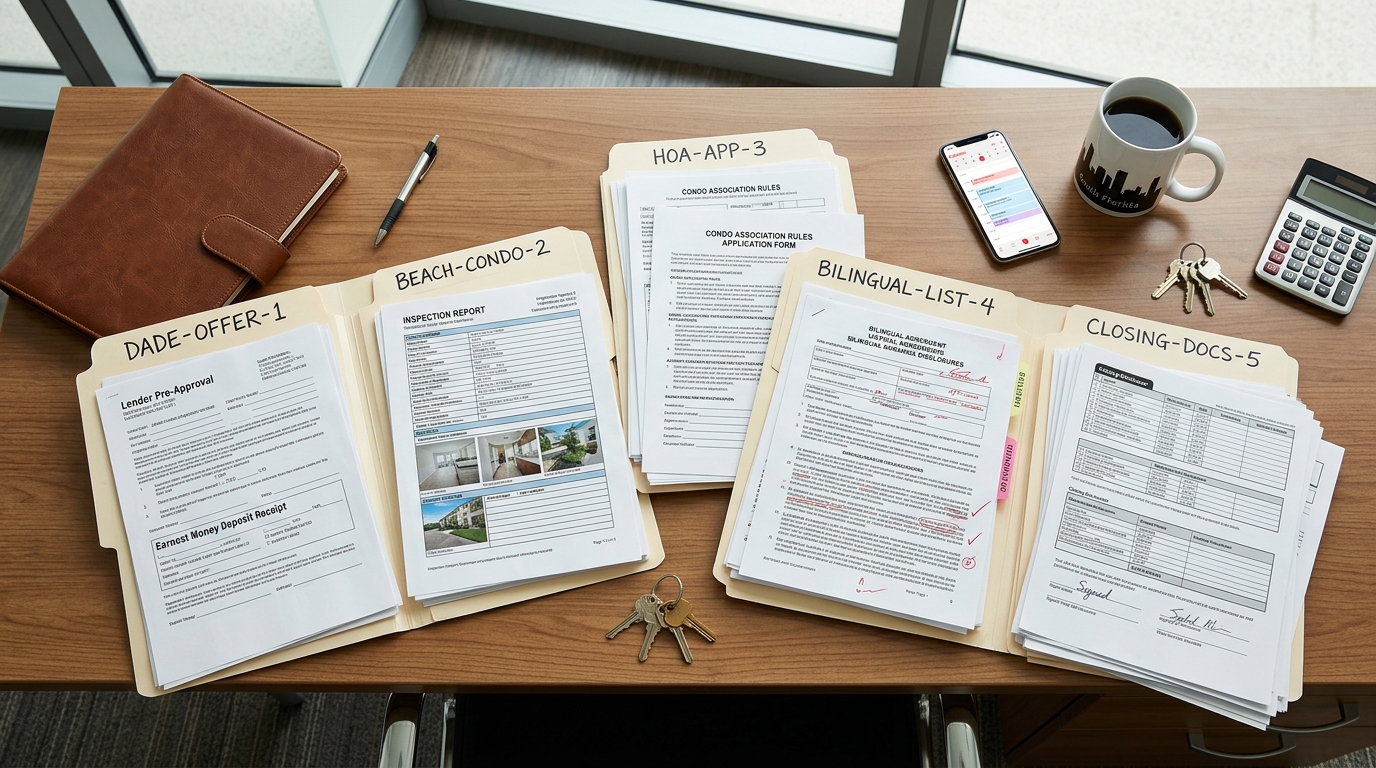
By Día 5, if you've sent two WhatsApp messages and a voice note with zero response, the instinct is to either spam harder or write the lead off. Neither works. Here's a decision tree developed from years of working in Hispanic real estate markets — it accounts for the fact that showing days create an admin pileup that tempts you to skip follow-up entirely.
- Check your message delivery: did the WhatsApp messages show double blue checks (read) or just double gray (delivered but unread)? Unread messages mean timing, not disinterest — try a different time of day.
- Make one phone call. In many Hispanic communication norms, a call signals seriousness and respect more than another text. Keep it under two minutes.
- If no response after the call, send a final WhatsApp text: 'No quiero ser insistente — solo quería asegurarme de que tiene mi información por si le surge algo más adelante. Con mucho gusto le ayudo cuando esté listo/a.'
- Move the contact to a monthly nurture cadence. Do not keep messaging weekly. Respect earns referrals even from buyers who don't transact with you.
That last point matters more than most agents realize. The referral math in Hispanic markets is disproportionate. A buyer who felt respected — even one who didn't buy — tells their cousin, their compadre, their church group. NAHREP's 2023 "State of Hispanic Homeownership Report" found that word-of-mouth referrals drive a meaningfully larger share of transactions in Hispanic communities than in the general market, citing stronger community and family networks as a primary driver. One follow-up gap can cost you the referral chain, not just the deal.
Build the System Once — Then Let It Run
The biggest risk with this sequence isn't that it's complicated. It's that showing days are chaotic, you're juggling three buyers and a listing appointment, and the Día 0 message never gets sent. By Día 3 you've forgotten what the buyer liked about the kitchen. The sequence dies before it starts.
That's a systems problem, not a discipline problem. The agents who run this consistently have one thing in common: they don't rely on memory. They use a trigger — a calendar reminder, a CRM task, a tool that fires the first message automatically — so the sequence starts whether they remember or not.
The follow-up sequence is only as good as the trigger that starts it. If the trigger is 'I'll remember to send it tonight,' it won't happen on your busiest showing day — which is exactly when it matters most.
You can build this in your CRM, a WhatsApp Business template, or a dedicated operational tool. Some agents use Follow Up Boss or LionDesk with custom automations; others use tools like Reddy that handle bilingual follow-up sequences natively. (Disclosure: Reddy is our product.) The point is the same regardless of tool: make Día 0 automatic, give Día 1–3 a nudge, and let Día 5–7 escalate based on response — not on whether you had time to check your notes.