How many group chats does one deal actually create?
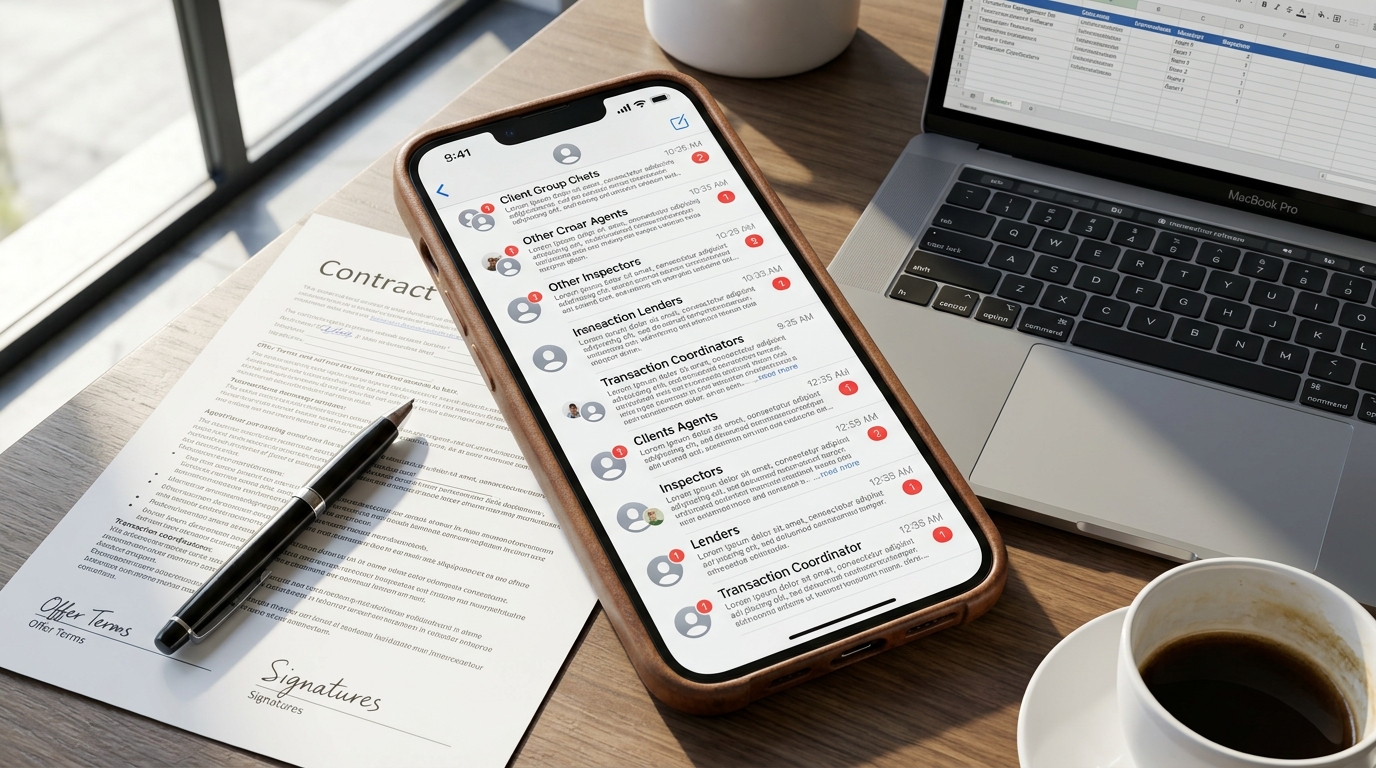
Most agents undercount. We've mapped this with agents running concurrent deals in South Florida, and the number is consistently higher than people expect. A single buy-side residential transaction typically generates four to seven distinct group chats across platforms — not counting one-on-one threads.
| Chat group | Platform (most common) | Active window |
|---|---|---|
| Buyer + agent | WhatsApp or iMessage | Entire deal (60–90 days) |
| Agent + lender + processor | WhatsApp or email thread | Pre-approval through clear-to-close |
| Agent + title company | Email or WhatsApp | Contract through closing |
| Agent + co-op listing agent | iMessage or Telegram | Offer through closing |
| Agent + inspector (+ buyer) | WhatsApp or iMessage | Inspection period (7–15 days) |
| Agent + insurance agent | iMessage or WhatsApp | Binding estimate through closing |
That's five to six chats for one deal. At four concurrent transactions, you're toggling between 20–24 active group threads — plus your one-on-one messages with each party. No consumer messaging app gives you cross-chat search. None of them version documents. None of them flag a deadline that was mentioned once in a thread 47 messages ago.
Five types of deal-critical information that vanish in scroll-back
Chat overload wouldn't matter much if every conversation were just status updates and scheduling. But material deal information — the kind that changes timelines, costs, and obligations — lives in these threads too. We've seen the same five categories get buried repeatedly.
- Amendment and extension deadlines. The lender's processor mentions in the group chat that the appraisal will be three days late and the agent needs to file an extension. That message lands between a loan estimate PDF and a "sounds good" reply. The extension doesn't get filed. The contract deadline passes.
- Lender conditions and document requests. A conditional approval comes in, and the lender drops a list of items needed in the WhatsApp group: bank statements, gift letter, updated pay stub. The buyer sees it but thinks the agent is handling it. The agent thinks the buyer saw it. Three days pass before anyone follows up.
- Inspection repair lists and seller responses. The inspector's summary gets shared in one group. The repair request goes out in the co-op agent thread. The seller's counter comes back via email. The buyer asks about it in the original buyer chat. Now the negotiation history is split across three threads and an inbox.
- Closing cost changes. The title company sends an updated closing disclosure in the title chat. The number is $1,400 higher than the buyer expected. The agent needs to loop in the lender. That conversation happens in a different group. The buyer doesn't get a clear answer for two days because nobody has the full picture in one place.
- Title objection and survey dates. In Florida, the title commitment review period is a contractual deadline. The title company may flag an issue in their chat, but the agent needs to coordinate a response in the co-op agent thread and inform the buyer separately. If the flag gets buried under other messages, the objection window closes silently.
The information isn't lost because it was never shared. It's lost because it was shared in the wrong thread, at the wrong time, to the wrong subset of people — and nobody had a system to catch it.
You are the single point of failure
Here's what most productivity advice misses: the scattered group chat problem isn't a time management issue. It's a business continuity risk. When deal communication lives across 20+ threads on your personal phone, you become the only person who knows where everything is. Your memory is the index. Your scroll thumb is the search engine.
That works fine — until it doesn't. You get sick for two days. You're in back-to-back showings and can't check every thread. You go on a short vacation and a teammate tries to cover your deals. They have no idea which chat has the lender's latest conditions. They can't find the title company's updated commitment. They don't know the inspector's report was shared in a group that doesn't include them.
This is the pattern we see agents hit right around three to five concurrent deals. It's the same inflection point where admin overload starts showing early warning signs — the kind we covered in our piece on recognizing admin overload before it costs you a deal. The difference with chat sprawl is that the damage is invisible until a deadline is missed or a client feels ignored.
Why "just use a CRM" doesn't solve this
The standard advice is to move all communication into a CRM like Follow Up Boss or kvCORE, or into a transaction management platform like Dotloop, SkySlope, or Open To Close. Those tools are genuinely useful for what they're built to do — pipeline tracking, document storage, task management.
But they don't solve the group chat problem, because they require every party to use them. Your buyer's lender is not going to log into your Dotloop portal to send a message. The co-op listing agent isn't going to install your team's Slack workspace. The title closer is going to keep texting you on WhatsApp because that's where they text everyone.
| Tool category | Good at | Doesn't solve |
|---|---|---|
| CRM (Follow Up Boss, kvCORE) | Lead tracking, contact management, automated drip sequences | Cross-party deal communication in real time |
| Transaction mgmt (Dotloop, SkySlope, Open To Close) | Document storage, task checklists, e-signatures | Capturing decisions and updates made in external chat threads |
| Team chat (Slack, Google Chat) | Internal team coordination, channel organization | External counterparties won't join your workspace |
| Consumer messaging (WhatsApp, iMessage, Telegram) | Fast, low-friction communication with anyone | Search, document versioning, deadline tracking, archiving |
The gap is clear: the tools that are good at organizing information require adoption. The tools that everyone actually uses offer no organization. That's the structural mismatch, and pinning messages or renaming chat groups doesn't close it. We explored this communication layer in more depth in our guide to using WhatsApp effectively for real estate client communication — the short version is that the app itself works, but it needs structure around it.
What a structured layer actually looks like
The practical answer isn't replacing your chat apps — it's adding a lightweight capture layer that pulls the important stuff out of chat threads and into a place where it's searchable, trackable, and visible to anyone who needs it. The key constraint: this layer has to work without requiring your counterparties to install anything new.
- Forwarding rules. Set up auto-forwarding from key WhatsApp groups to a shared deal board — tools like Zapier can bridge WhatsApp Business messages to Notion, Trello, or a shared Google Sheet organized by deal.
- Daily extraction habit. At the end of each day, spend 3–5 minutes scanning your active deal chats and pulling any deadline, document, or decision into your transaction file. This is the minimum viable habit that prevents scroll-back archaeology later.
- Single-deal summary thread. Create one internal thread (Slack channel, Notion page, or even a pinned note) per deal where you log every material update regardless of which chat it came from. This becomes your searchable deal history.
- Document forwarding. Any PDF, photo, or file shared in a chat group gets immediately saved to the deal's document folder. Don't rely on finding it later in a chat thread — messaging apps compress images, expire links, and make files nearly impossible to retrieve after a few weeks.
None of this is glamorous. It's operational hygiene. But agents who build even a basic version of this layer tell us the same thing: they stop worrying about what they forgot, because the system catches it instead of their memory.
The goal isn't zero group chats. It's making sure the group chat isn't also your filing cabinet, your calendar, and your only deal record.
Where Reddy fits in this picture
This is the exact problem we're building Reddy to address. Not by replacing WhatsApp or iMessage — agents use those because they work for conversation — but by acting as the structured layer that captures, organizes, and tracks what happens across all your deal threads.
Think of it as an operational assistant that watches the communication flow and makes sure deadlines, documents, and decisions don't stay buried. It works inside your existing chat workflow so you don't have to convince a title company or lender to adopt a new platform.
We're not going to promise it eliminates every problem in this article overnight. But if you're running three or more deals and the only thing connecting all the moving pieces is your memory and your scroll thumb, that's a conversation worth having.