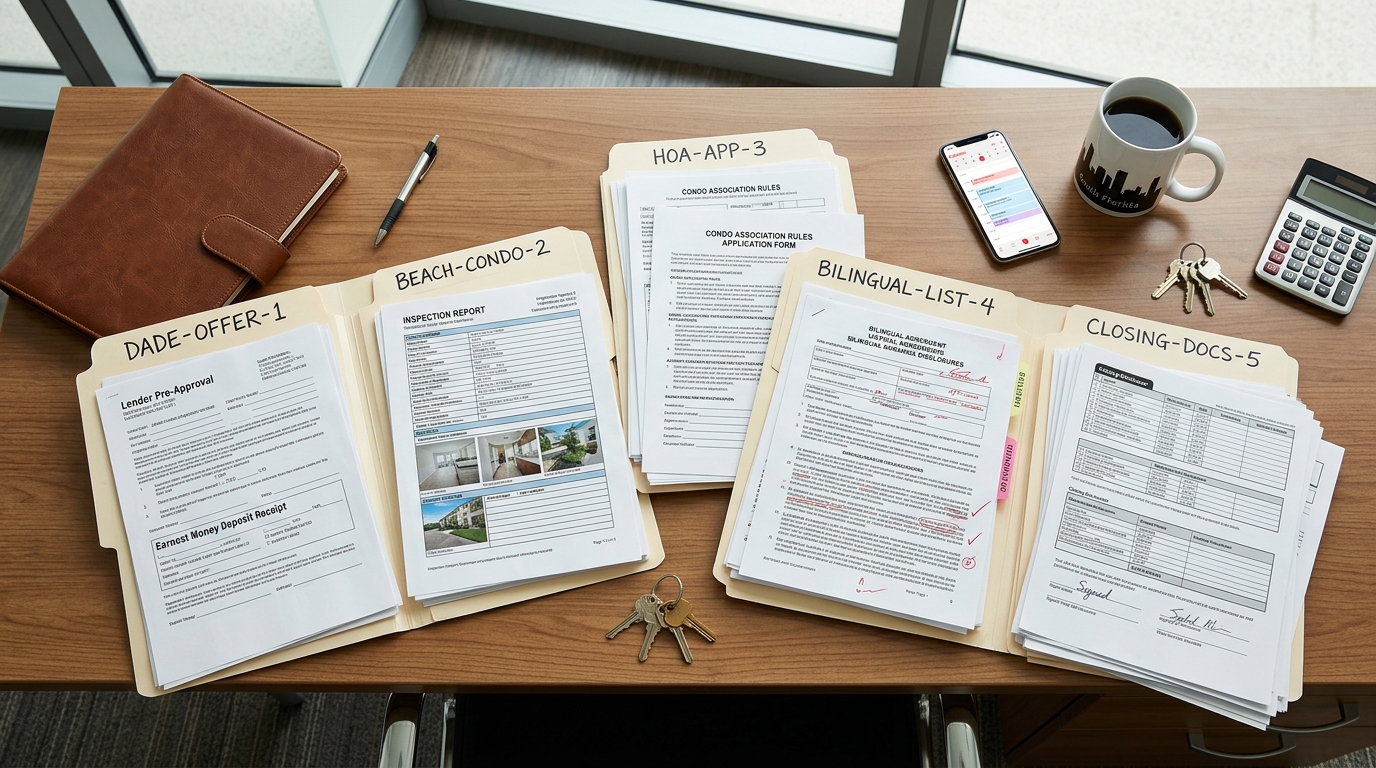

Why agents keep running deals through WhatsApp (and why they're right to)
Let's get this out of the way: using WhatsApp for deal management isn't lazy. It's rational. Your clients are already there. They respond faster there than email. And in markets like South Florida — where half your deals involve at least one party who prefers Spanish — WhatsApp isn't optional. It's the default.
The real estate industry keeps pushing CRMs and transaction management platforms that require everyone to log into something new. But the adoption math never works. Your buyer in Hialeah isn't downloading Dotloop to check their closing status. They're going to text you. On WhatsApp.
The problem was never WhatsApp. The problem is that WhatsApp has no structure — no deadlines, no document tracking, no audit trail. Reddy adds the structure without replacing the channel.
That's the core idea. Keep the tool your clients actually use. Add the operational layer that's missing.
The deal: a typical buyer-side transaction
To make this concrete, let's follow a deal. You're representing a buyer on a $485K condo in Doral. Your client communicates primarily in Spanish. The listing agent uses English. You've got a lender, a title company, and an inspector — all feeding you documents, updates, and questions through a mix of WhatsApp and email.
Here's how the deal typically unfolds without any structure — and then what changes when Reddy is running alongside your WhatsApp workflow.
Step 1: The offer goes out — and the document trail starts
Day one. You send the signed offer to the listing agent. Your buyer sends you a photo of their pre-approval letter on WhatsApp because that's easier than scanning it. The lender also WhatsApps you a cleaner copy an hour later.
Without structure, you now have two versions of the same document floating in two different chat threads. By the time you need it again — maybe when the title company asks — you're scrolling, squinting at thumbnails, and hoping you grab the right one.
With Reddy connected, here's what changes:
- You forward the pre-approval letter to Reddy via WhatsApp. It logs the document, tags it to the deal, and confirms receipt.
- When the lender sends the updated version, you forward that too. Reddy notes it as a newer version — no confusion about which is current.
- If the title company asks you for it later, you don't scroll. You ask Reddy, and it surfaces the latest version.
The documents still flow through WhatsApp. You're not uploading files to a portal. You're forwarding them to an assistant that actually keeps track.
Step 2: Inspection period — where deadlines get dangerous
Your contract gives you a 15-day inspection period. That sounds like plenty of time until you're juggling three other deals, a showing schedule, and a client who keeps asking about the HOA reserves.
The inspection deadline doesn't care that you were busy. Miss it, and your buyer's leverage evaporates.
| Without Reddy | With Reddy |
|---|---|
| You set a phone reminder for Day 12 and hope you see it | Reddy tracks the deadline from the contract date and nudges you at intervals you set |
| Inspector sends the report as a PDF in WhatsApp — it scrolls away fast | You forward the report to Reddy; it's logged and tied to the inspection milestone |
| Your buyer asks for a summary in Spanish — you paraphrase on the fly | Reddy can help you communicate the key points in Spanish without losing deal context |
| You forget to send the repair request until Day 14 | Reddy flags the approaching deadline so you have time to act, not react |
If you've ever been on the wrong side of a missed inspection deadline, you know this isn't a convenience feature. It's protection. And for bilingual agents managing this across two languages — where a client might not understand the urgency of a contractual deadline in English — having that extra layer matters even more. We wrote about how bilingual operations break differently than English-only workflows in a separate post.
Step 3: The mid-deal grind — lender updates, title requests, client questions
This is the part of every deal that doesn't get talked about enough. Between contract and closing, there's a steady drip of requests. The lender needs a bank statement. Title needs the survey. Your buyer wants to know if they can do a final walkthrough on Saturday. The listing agent asks about the closing date for the fourth time.
Each of these is small. None of them individually will kill the deal. But collectively, they're the reason agents feel like they're drowning in admin by deal number three.
- Lender WhatsApps you asking for an updated bank statement from your buyer.
- You message your buyer — in Spanish — asking them to send it.
- Buyer sends it to you two days later at 11pm.
- You forward it to the lender the next morning.
- Lender confirms receipt but asks for one more month.
- You message the buyer again.
- Repeat.
That's six messages across three threads for one document. And you're mentally tracking all of it.
When Reddy is running, it tracks what's been requested, what's been received, and what's still outstanding. You're not carrying the entire deal state in your head. If something's missing for three days, you get a nudge. You don't have to remember — the system remembers.
The goal isn't to remove you from the conversation. It's to remove the mental overhead of tracking every thread, every document, and every deadline across every deal — so you can actually focus on the conversations that matter.
Step 4: Closing week — when everything compresses
Closing week is where deal management either holds or falls apart. Final walkthrough. Wire instructions. Last-minute lender conditions. The title company sending the CD for review. Your buyer asking what to bring. The listing agent confirming the closing time.
In a WhatsApp-only workflow, closing week looks like 15 unread threads and a prayer that you didn't miss anything. Here's what Reddy helps you stay on top of:
- Outstanding documents flagged — you can see what's still missing without checking every thread.
- Closing date and time confirmed and tracked, with reminders going out to you and (if you want) your client.
- Wire instruction handling — the most sensitive document in the deal — forwarded and logged, not lost in a chat scroll.
- A record of what was sent, when, and to whom — the audit trail that WhatsApp alone can't give you.
What about the audit trail?
This is the part that should matter to your broker, but let's be honest — it should matter to you too.
If a deal goes sideways three months after closing — a dispute about disclosures, a question about what was communicated and when — your WhatsApp threads are a mess of memes, voice notes, and forwarded PDFs with no timestamps that mean anything.
Reddy creates a structured log of deal activity. Documents received. Deadlines tracked. Communications flagged. It's not a legal compliance tool — but it's a massive step up from "I think I sent that in March, let me scroll back."
This connects to a broader point about follow-up systems. If you've read our piece on follow-up sequences that run without you, you know the pattern: the system handles the tracking so you can handle the relationships. Same principle applies here, just inside WhatsApp instead of alongside it.
What this doesn't replace
Let's be direct about what Reddy inside WhatsApp isn't.
- It's not a full transaction management platform like Dotloop or SkySlope. If your brokerage requires one of those, you'll still use it for compliance submissions.
- It's not a CRM. It doesn't replace your lead pipeline or marketing automation.
- It doesn't auto-respond to your clients or pretend to be you. You're still the agent. The relationship is still yours.
- It's not a replacement for professional legal, title, or lending services. It's an operational layer — not a licensed advisor.
What it does is fill the gap between the platform your clients actually use and the structure your deals actually need. That gap is where most agents lose time, miss deadlines, and burn mental energy they should be spending on the next deal.
Who gets the most out of this
Not every agent needs this. If you're running two deals a year through email and a filing cabinet, you're probably fine. But if any of the following sound familiar, this is built for you.
| Signal | Why it matters |
|---|---|
| You manage 3+ active deals at a time | The mental overhead of tracking multiple WhatsApp threads per deal compounds fast |
| Your clients prefer WhatsApp over email | You can't force channel adoption — you have to meet clients where they are |
| You work in two languages | Deal context gets lost in translation when you're toggling between Spanish and English threads without structure |
| You've missed a deadline or lost a document in chat | Once is a lesson. Twice is a pattern. Structure prevents both. |
| You don't want to learn another platform | Reddy works inside WhatsApp — not instead of it |
If you're a bilingual agent in a market like South Florida, this is especially relevant. The operational complexity of managing deals across two languages inside an unstructured chat app is real — and it's a problem we've written about in depth when exploring why bilingual real estate is an operations problem, not a translation problem.
The bottom line
You're not going to stop using WhatsApp for deals. Your clients aren't going to stop messaging you there. The question isn't whether WhatsApp is the right tool — it's whether you can add enough structure to it that deals don't fall through the cracks.
Reddy is built to be that structure. Document tracking. Deadline management. Follow-up nudges. An audit trail that actually exists. All running inside the WhatsApp workflow you're already using, not in some dashboard you'll check once and forget.
The best system isn't the most powerful one. It's the one you actually use. If that's WhatsApp, then that's where your deal management should live too.