
The format: 30 minutes, three parts, no slides
The call runs 30 minutes. You'll book it through our scheduling link, pick a time that works, and get a confirmation with a video-call link. There's no deck. No pre-recorded walkthrough. The call is live, conversational, and split into three distinct parts.
| Segment | Time | What happens |
|---|---|---|
| Your operation | ~10 min | We ask about your deal volume, current tools, and where admin work stalls your week. |
| Live walkthrough | ~12 min | We share our screen and show Reddy handling a scenario based on what you just told us — not a canned demo. |
| Your questions + next steps | ~8 min | You ask anything. We explain what happens after and whether Reddy is a fit. No closing pitch. |
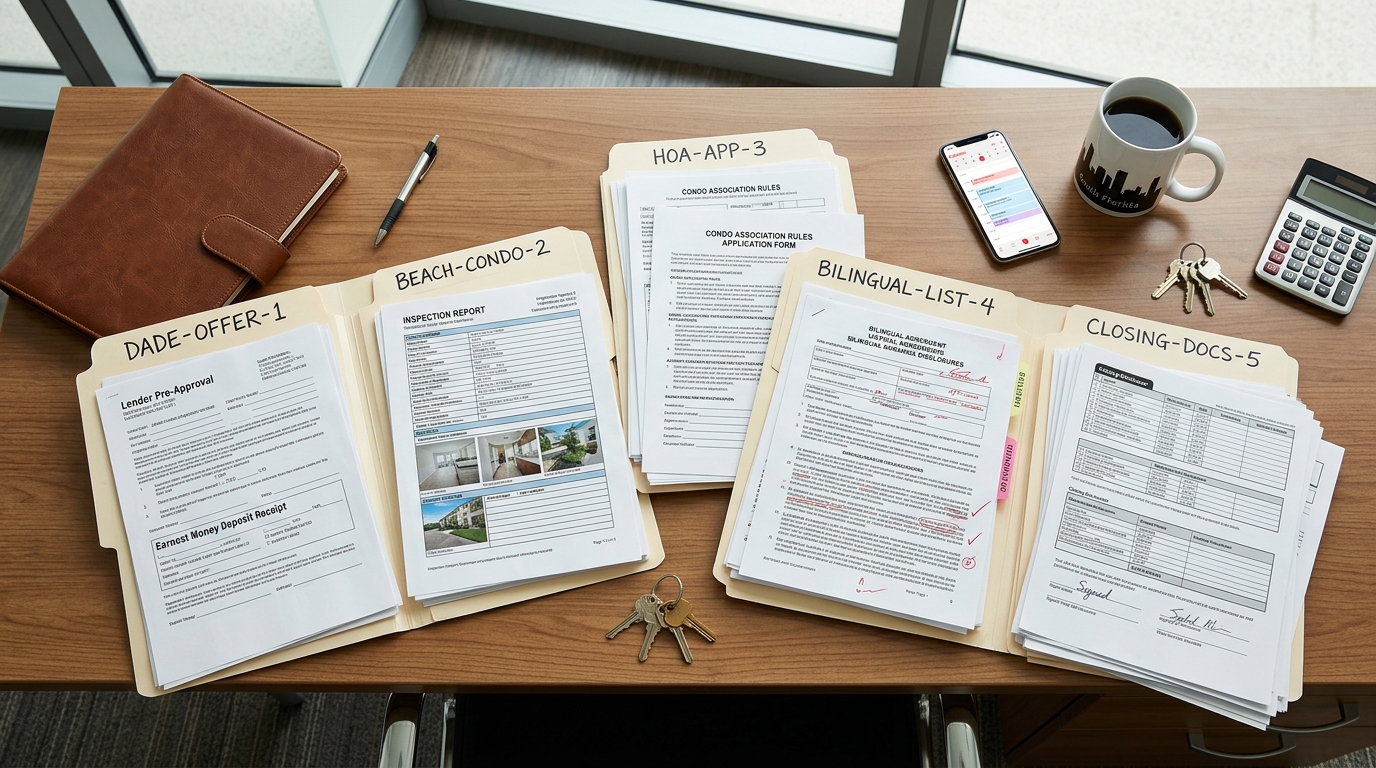
What to Bring to a Reddy Real Estate Operations Call
Most vendor demos go sideways because nobody tells you what to prepare. The rep shows a generic walkthrough, you nod politely, and you hang up no closer to a decision. Here's what makes this call productive instead of performative.
- Your current monthly deal volume — even a rough number like '3–5 active at a time' is enough for us to tailor the walkthrough.
- The tools you're already using — your CRM (Follow Up Boss, KVCore, Sierra Interactive, or something else), your transaction management setup, and how you handle e-signatures.
- Your single biggest bottleneck — the task that eats the most time or falls through cracks the most often. For many agents we talk to, it's post-contract follow-up or bilingual coordination.
- Whether you work solo or with a team — the call shifts depending on whether you're an individual agent managing everything or a team lead delegating to an assistant or TC.
Specificity is what separates a useful call from a forgettable one. Here's what we mean:
| Prep item | Vague answer (slows us down) | Specific answer (gets you real answers) |
|---|---|---|
| Tech stack | "I use a CRM." | "I'm on Follow Up Boss, transactions go into Google Drive folders, e-signs through DocuSign." |
| Deal volume | "I'm pretty busy." | "I close 4–6 deals a month and usually have 8–10 active contracts at any time." |
| Bottleneck | "Admin stuff takes too long." | "I lose 2–3 hours a week chasing HOA docs and title updates between contract and clear-to-close." |
| Team structure | "I have some help." | "I have a part-time VA who handles listing input and a TC who manages contracts, but neither touches post-close." |
The agents who get the most out of this call aren't the ones with the best questions — they're the ones who show up knowing their own operation well enough to say 'this is where I'm stuck.'
You don't need to study Reddy ahead of time. That's our job on the call. But knowing your own numbers and pain points means we skip the surface-level stuff and get to whether this actually solves something for you. If you're curious what Reddy typically handles in the first seven days, our walkthrough of the first week covers it in detail.
What happens in the 48 hours after
This is the part no one ever tells you, and it's usually where trust breaks down. You finish a demo, close the tab, and then get three follow-up emails, a text, and a call from a number you don't recognize. Here's what actually happens after a Reddy intro call.
- Within a few hours, you get a short recap email summarizing what we discussed and the specific scenarios we walked through — not a generic brochure.
- If Reddy looks like a fit, the email includes a clear next step: either a trial setup or a second call to go deeper on your workflow. No 47-step onboarding funnel.
- If it's not a fit, we tell you on the call. You won't get a follow-up sequence pretending we didn't both already know that.
- You won't receive cold outreach from a separate 'sales team' you've never spoken to. The person on the call is the person in your inbox.
For context: roughly 1 in 4 intro calls — about 23% over the last quarter — end with us telling the agent that Reddy isn't the right fit for their operation right now. That's not a failure; it's the whole point of the call. The agents who do move forward typically go from first call to active trial in 5 business days, with most of that time spent on their side deciding, not ours setting up.
Who this call is NOT for (and how to self-select honestly)
We'd rather save you 30 minutes than waste them. This call probably isn't the right move if any of these apply to you right now.
- You're closing fewer than one transaction per month on a rolling three-month average — meaning fewer than three closed sides in the past 90 days. At that volume, an operational tool like Reddy doesn't pay for itself yet. (If you're counting active contracts or listings taken rather than closed deals, the threshold is roughly two or more active contracts at any given time.)
- You don't use any digital transaction files — everything is paper-based and you're not planning to change that soon.
- You're looking for a full-service transaction coordinator who will call lenders and attend inspections on your behalf — that's a human TC role, not what Reddy does.
- You want a generic AI chatbot for lead generation. Reddy is built around deal context and admin operations, not cold outreach. We explain why that distinction matters in our post on why real estate AI needs deal context.
If you read that list and none of it applies, the call is probably worth your time. And if you're on the fence about whether your volume or workflow qualifies, you can ask us before you book — there's no minimum commitment to get a straight answer.
A quick real estate case study from a recent call
To give you a sense of how these calls actually play out beyond the format: a Houston-based agent doing about 6 closings a month booked a call expecting to talk about CRM integrations. Within the first ten minutes, we zeroed in on something she hadn't identified as her core problem — bilingual disclosure coordination. She was serving a mixed English-Spanish client base and spending roughly 4 hours a week manually cross-referencing disclosure packets to make sure both language versions matched and were sent to the right parties at the right time.
On the live walkthrough, we showed her how Reddy flags mismatched disclosure versions automatically and routes the correct language set based on client preferences stored in the deal file. She started a trial two days later and, within her first full month, reported reclaiming about 12 hours of admin time — almost entirely from that one workflow she hadn't thought to ask about.
That's what a good intro call does. It doesn't just confirm what you already know — it surfaces the bottleneck you've been working around without realizing how much it's costing you.
How to spot a bad vendor demo (and what we do differently)
You've probably sat through demos that felt more like hostage negotiations than consultations. Here's a quick way to tell the difference — and to hold us accountable to the same standard.
| Red flag | What Reddy does instead |
|---|---|
| Pre-recorded 'personalized' walkthrough | Live screen share tailored to the workflow you described in the first 10 minutes |
| Rep can't answer questions without 'checking with the team' | The person on the call works inside the product daily and can answer operational questions in real time |
| Hard close with a 'today-only' discount | No artificial urgency — the pricing is the pricing whenever you're ready |
| No mention of what happens if it's NOT a fit | We disqualify openly on the call if the product doesn't match your operation |
| Follow-up from a different rep you've never talked to | Same person, same thread, same context |
The best demo you'll ever sit through is the one where the rep tells you it's not a fit — and means it. That's the bar we're trying to clear.