
What 'context window' actually means for a 45-day deal
Every AI tool — ChatGPT, Claude, Gemini — runs on a large language model with a context window. That window is the amount of text the model can hold in working memory during a single conversation. GPT-4o's window is roughly 128,000 tokens, which sounds like a lot until you consider what a single real estate deal actually contains.
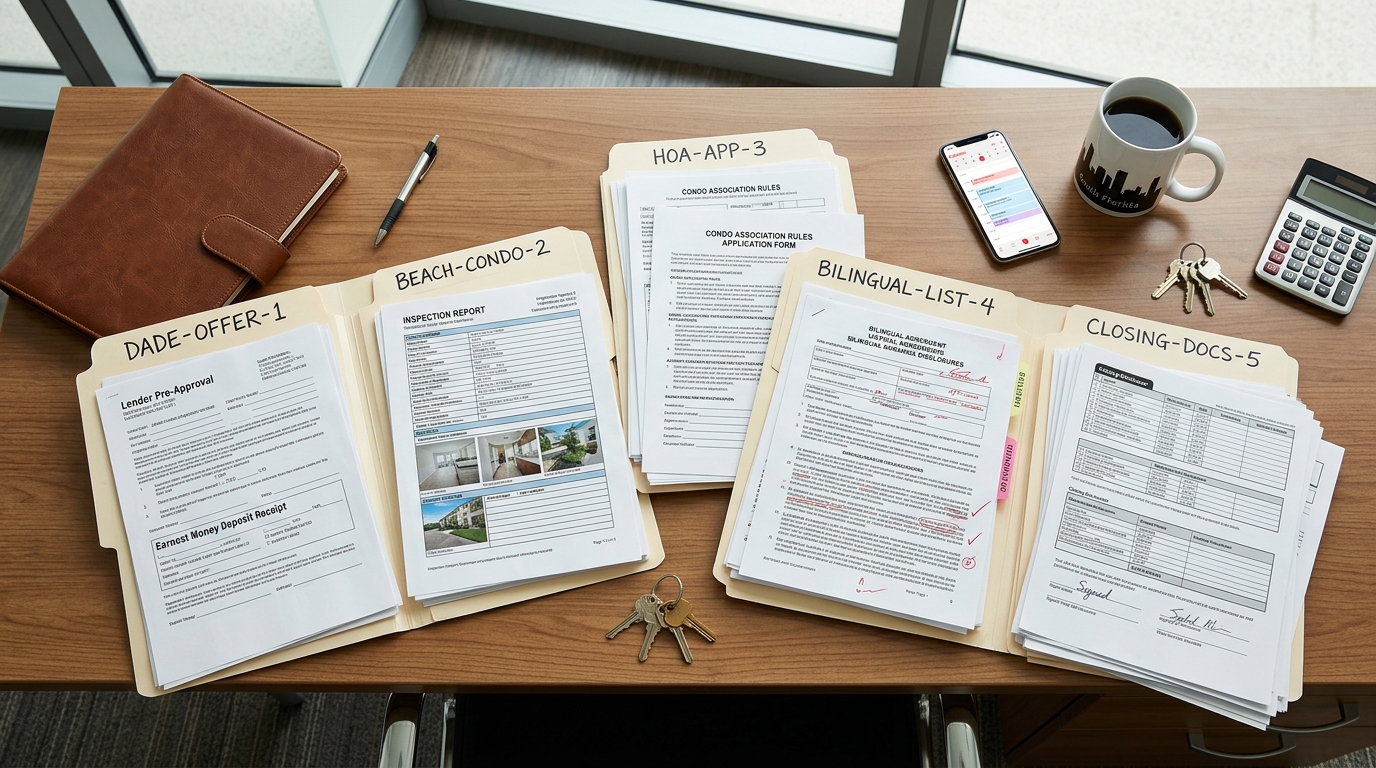
A typical residential transaction generates buyer and seller contact details, showing notes, offer terms, counter-offer history, inspection findings, lender communications, title updates, and closing coordination across 20 or more contacts over 30 to 60 days. That's not one conversation — it's hundreds of messages, documents, and decisions spread across weeks.
Even within a single long session, token limits create a ceiling. Paste in your full deal file, contact list, and recent email thread and you've consumed most of the window before you've asked your first question. The model starts dropping earlier details to make room for new ones. For agents juggling concurrent closings, that ceiling arrives fast.
The hidden time tax of re-feeding context
We've seen agents build elaborate workarounds for this problem. They maintain a Google Doc with deal summaries they paste into every new ChatGPT session. They write prompt templates with placeholders for property address, buyer name, contract stage, and deadlines. Some agents spend 5 to 10 minutes at the start of each AI session just loading context back in.
That's the hidden tax. If you use AI for deal work across three active transactions and open a new session twice a day, you're spending 30 to 60 minutes a week just re-teaching the tool what it already knew yesterday. The productivity gain AI was supposed to deliver gets eaten by the context re-entry overhead.
The irony of using AI to save time on deal admin: the time you save on the task, you spend on the context. Agents aren't bad at prompting — they're trapped in a tool that forgets.
And it compounds. The more deals you run, the more context you have to manage, the more sessions you open, and the more re-feeding you do. Solo agents hit this wall around three concurrent deals. Teams hit it even faster because the context lives in one person's prompt templates, not in a shared system.
Why real estate deals are uniquely hard for generic AI
Not every use case breaks stateless AI this badly. Writing blog posts, generating social captions, summarizing articles — those are single-session tasks with self-contained context. You give the model everything it needs in one prompt. Real estate transactions are different because the context is relational, temporal, and conditional.
| Dimension | What it means for AI | Example |
|---|---|---|
| Relational | Multiple entities connected to one deal | Buyer, seller, lender, title agent, inspector — each with different contact preferences and update needs |
| Temporal | Information changes meaning over time | An inspection objection has different urgency at day 5 vs. day 14 of a 15-day contingency |
| Conditional | Next steps depend on prior outcomes | Appraisal comes in low → triggers renegotiation path, not the standard closing prep sequence |
Generic AI tools don't model these relationships. They process whatever text you feed them right now. They can't tell you that the Garcia closing is at risk because the lender hasn't sent the clear-to-close and the deadline is Friday — unless you type all of that in first. A deal-aware tool would already know.
This is also why CRMs adding an AI chat feature often disappoint. Tools like Follow Up Boss, kvCORE, or Lofty may bolt on GPT-powered responses, but the AI layer typically can't access your full deal state — it sees the CRM record, not the living transaction with all its moving parts.
Stateless vs. stateful: the distinction nobody is explaining
In AI architecture, stateless means the system treats every interaction as independent. Stateful means the system maintains knowledge across interactions. Most tools agents use today — including ChatGPT, Claude, and CRM chatbots — are fundamentally stateless for deal work. Even ChatGPT's memory feature stores general preferences, not structured deal data.
- Stateless AI processes your words. You describe the deal, it generates output based on that description, then it forgets.
- Stateful AI understands your deals. It knows your pipeline, tracks deadlines across transactions, and references prior conversations without being told to.
- The gap between these two isn't a feature update — it's a different architecture. Stateful deal awareness requires persistent memory, structured data retrieval, and multi-entity relationship modeling.
Some teams try to bridge this with retrieval-augmented generation (RAG) — feeding documents into a vector database so the AI can pull relevant context when prompted. It's a step forward, but RAG alone doesn't solve the temporal and conditional problems. Knowing that a document exists is not the same as knowing where you are in a deal timeline and what should happen next.
Transaction management platforms like Dotloop, SkySlope, or Brokermint hold structured deal data, but their AI features tend to be task-specific: auto-filling forms, flagging missing signatures. They don't give you a conversational assistant that reasons across your full pipeline. The architecture for truly deal-aware AI requires combining persistent state, structured retrieval, and conversational reasoning — and that's what most tools haven't built yet.
Five questions to evaluate if an AI tool is actually deal-aware
If you're evaluating any AI tool for real estate operations — whether it's a standalone assistant, a CRM add-on, or a transaction platform — these five questions separate deal-aware tools from prompt processors. Ask them before you commit time or money.
- Does it remember your pipeline between sessions? Open the tool tomorrow without pasting anything. Ask it which of your deals closes next. If it can't answer, it's stateless.
- Can it distinguish between your deals without being told which one you mean? Say 'the inspection deadline' and see if it knows you're talking about 742 Oak Street, not 315 Coral Way. Context-aware tools resolve ambiguity from deal state.
- Does it know what stage each deal is in and what should happen next? Not just what you told it five minutes ago — but derived from actual transaction data, deadlines, and contingency timelines.
- Can it reference a prior conversation about a specific contact? Ask it 'what did I say about the Garcia appraisal last week?' If it can't retrieve that, it has no persistent memory of your work.
- Does it update its understanding when deal status changes? When a deal moves from under-contract to pending, does the tool's behavior change — surfacing closing tasks instead of negotiation support — or does it wait for you to announce the change?
This isn't about finding the perfect tool today. It's about knowing what to look for so you stop blaming your prompting skills for a problem that lives in the tool's architecture. The agents we've talked to who made progress didn't get better at prompting — they moved to tools that carried context forward. That shift changes everything about whether AI is a net time saver or just another thing to manage.
Better prompts won't fix a memory problem
The real estate AI conversation has been stuck on prompts for two years. "Write better prompts for listing descriptions." "Use this template for buyer follow-ups." "Try this GPT wrapper built for agents." That advice isn't wrong — but it addresses the wrong constraint. It's like telling an agent to write neater sticky notes when the real problem is that the sticky notes get thrown away every night.
The constraint that matters is deal context: whether the AI tool you're using can hold the full state of your transactions across sessions, reference prior interactions, and reason about what should happen next based on where each deal actually stands. That's an architecture question, not a prompting question.
An AI tool that understands your deals doesn't need a perfect prompt. An AI tool that doesn't understand your deals can't be saved by one.
If you've hit the wall with ChatGPT or Claude for deal work, you're not doing it wrong. You've found the edge of what stateless AI can do for a workflow that is fundamentally stateful. The next step isn't a better prompt library — it's a tool built to carry your deal context forward. Reddy is building exactly that kind of deal-aware operational assistant. If you want to see what it looks like when AI actually remembers your pipeline, book a call and we'll walk you through it.