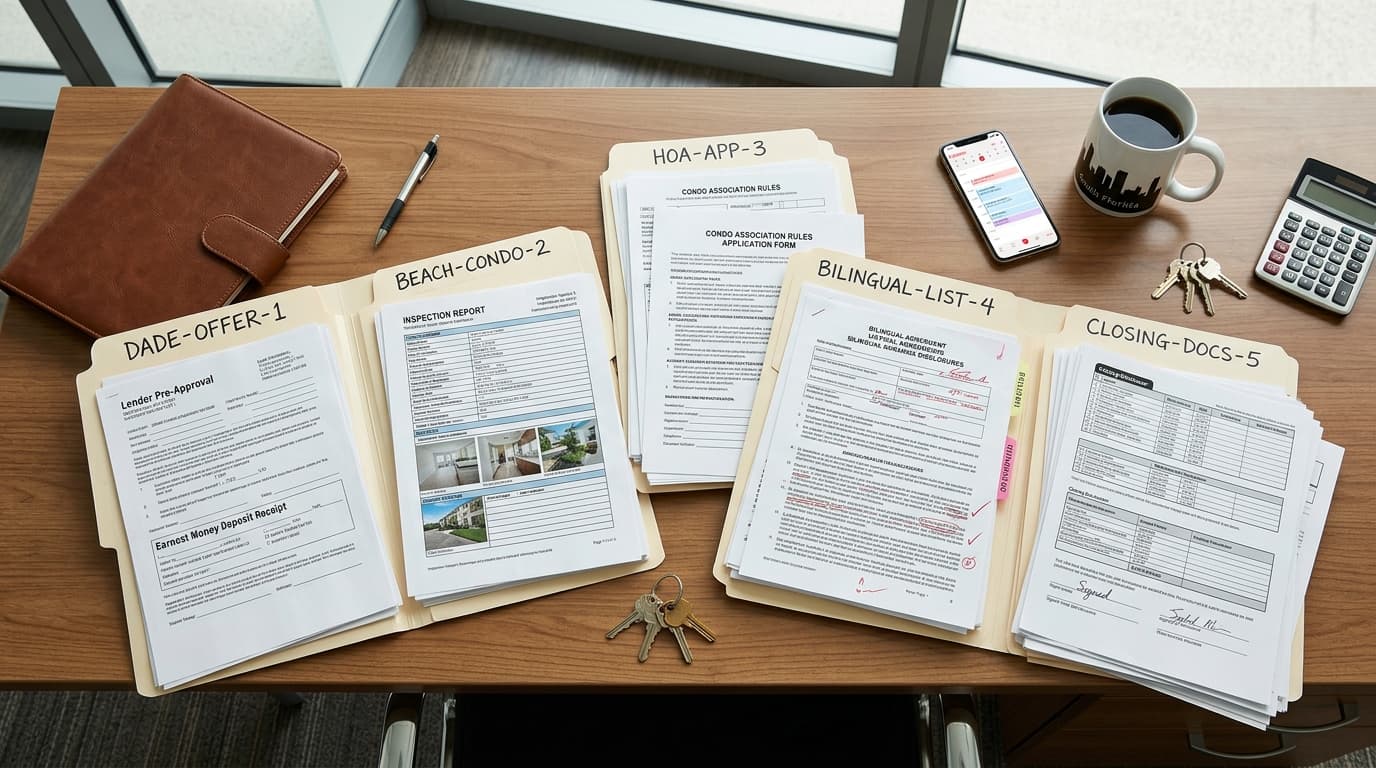
Your pre-appointment listing presentation checklist
Create one folder for the appointment and complete this checklist in order. Each item should be specific to the property and seller rather than copied unchanged from your standard presentation.
- Confirm the property address, ownership names provided by the seller, contact information, appointment time, and everyone expected to participate.
- Collect the seller's stated priorities: preferred timing, reason for moving, price expectations, showing limitations, and concerns about preparing the home.
- Verify the property's relevant facts from the records and information available to you. Mark anything that still needs confirmation instead of guessing.
- Inspect the home and record condition, improvements, unfinished work, features, room use, access instructions, and presentation issues that could affect your analysis or launch plan.
- Build a comparable set using recent sales, current competing listings, and relevant expired listings.
- Write a recommended price or price range and identify the comparables and property differences that support it.
- Prepare a one-page marketing plan for this home, including preparation, assets, launch channels, showing communication, and seller responsibilities.
- List the decisions you need from the seller: price, preparation work, showing availability, launch timing, and any optional marketing choices.
- Prepare your brokerage-approved listing agreement and other required forms using confirmed information. Leave unknown values open for discussion.
- Print or save a clean appointment packet and a separate working copy containing your private notes and questions.
Confirm the seller's priorities before you finish the deck
Price is only one part of the decision. The Keller Williams Listing Presentation PowerPoint frames the seller's objectives as pricing at fair market value, reaching the desired timing, and reducing inconvenience. Use those three subjects to uncover the tradeoffs this seller cares about.
Send a short confirmation message before the appointment. The answers will help you adjust the presentation, prepare the right questions, and avoid walking in with an irrelevant plan.
Hi [Seller name], I am preparing for our meeting about [property address] on [day and time]. Before I finish the pricing and marketing plan, could you reply with three things: your ideal moving timeline, any work or improvements completed since you bought the home, and any limits we should consider for showings? Please also let me know who will be at the meeting and what you most want answered. I will bring the comparable sales, recommended price approach, marketing plan, and next-step options for us to review.
Do not treat the seller's initial price expectation as either a command or an objection to defeat. Record it, ask what information shaped it, and compare that reasoning with the evidence you bring.
Build a price recommendation you can explain
The Keller Williams Listing Presentation PowerPoint describes a competitive market analysis using recent sales, current listings as competition, and expired listings as properties that have not sold. It also says buyers make pricing decisions by comparing a property with other properties sold in the area. Organize your evidence in those three groups so the seller can see that they answer different questions.
| Evidence | Question it helps answer | How to use it |
|---|---|---|
| Recent sales | What have buyers and sellers recently agreed to? | Start with the closest alternatives, then explain meaningful differences from the subject home. |
| Current listings | What will buyers compare with this home now? | Show the seller where the property would sit among active choices at the proposed price. |
| Expired listings | Which comparable listings did not sell during their listing period? | Use them as context, not as proof of value. Note relevant differences in price, condition, presentation, or terms without claiming a single cause. |
For every comparable, record the source, status, relevant dates, price information, proximity, basic property characteristics, condition information available to you, and the reason you included it. Remove a property if you cannot explain why a seller or buyer would reasonably compare it with the subject.
Reddy can pull recent comparable sales for a US home from live data, save a comp set, and produce an estimated value and price range. You can tell it which comparables to exclude or annotate and request a client-ready CMA PDF. Check every comparable and number before sharing the report.
- State the relevant facts of the subject property.
- Show the strongest recent sales first and explain why each one belongs in the comparison.
- Identify the important differences between each comparable and the subject.
- Show the current competition at the price you are considering.
- Review relevant expired listings without assuming why they failed to sell.
- State your recommended price or range.
- Name the evidence that would make you reconsider the recommendation before launch.
Use a simple comparison grid instead of hiding the reasoning
A seller does not need every field in your research file. They need to see the few comparisons that drive your recommendation. The hypothetical structure below shows how to present that reasoning without pretending the homes are identical.
| Property | Status | Relevant similarities | Relevant differences | Role in the recommendation |
|---|---|---|---|---|
| Subject home | Not yet listed | Baseline property | Condition and features confirmed during your walkthrough | The property being priced |
| Comparable A | Recent sale | Similar location and basic property profile | Updated interior; smaller outdoor area | Evidence from a completed sale, considered with the differences |
| Comparable B | Recent sale | Similar size and condition | Different lot or parking arrangement | A second completed-sale reference |
| Comparable C | Current listing | Likely to appear in the same buyer search | Different condition and asking price | Current competition, not a completed-sale value |
| Comparable D | Expired listing | Similar property profile | Did not sell during its listing period | Context for a pricing and positioning discussion |
Turn the marketing section into a plan for this home
The Keller Williams Listing Presentation PowerPoint includes MLS input, internet exposure, signage, information flyers, advertising, a broker open house, showing feedback, pricing guidance, staging guidance, and negotiation among its marketing actions. Do not present a long channel list as if it were already a plan. Select the actions you will actually use, connect them to this property, and define the next deliverable.
| Stage | Agent work | Seller decision or responsibility | Appointment output |
|---|---|---|---|
| Property preparation | Recommend presentation priorities and identify the information or access needed to prepare marketing assets. | Choose which cleaning, repair, staging, or preparation items to complete. | Agreed preparation list with an owner for each item |
| Asset preparation | Plan the property description, photography needs, flyer, sign, and any property-specific materials you intend to use. | Confirm property facts and approve access for asset creation. | Asset checklist and approval path |
| Launch | Define the listing channels, initial promotional actions, showing process, and any broker or public event you propose. | Approve the launch date, showing availability, and access instructions. | Launch sequence |
| Active marketing | Provide showing feedback, monitor current competition, and bring proposed changes to the seller for discussion. | Keep the home available under the agreed showing plan and respond to decisions that require seller approval. | Communication rhythm and decision process |
| Offer review | Present contract terms and represent the seller in negotiations within your role. | Review the choices, ask questions, and make the seller's decision. | Offer-review process |
Make the plan visibly property-specific. Name the features you will emphasize, the rooms or exterior areas that need preparation, the seller's access limits, the materials you will create, and the channels you have selected. If an action is optional, label it as optional instead of quietly promising it.
Separate controllable decisions from outside conditions. The Keller Williams presentation lists condition, showing availability, and price among seller-controlled factors, while competition, market conditions, interest rates, and the arrival of a buyer sit outside the seller's control. Use that distinction to keep the conversation on choices the seller can make.
Run the appointment as a sequence of decisions
Do not open with a long biography or read every slide. Set the agenda, confirm what you heard, and move from the seller's goals to the evidence and decisions.
I would like to start by confirming what matters most to you, then walk through the home and the market evidence behind my price recommendation. After that, we can review the preparation and marketing plan, decide what you want to change, and go through the next steps if you are ready to move forward. What would you add to that agenda?
- Confirm the seller's goal, timing, concerns, and decision-makers.
- Ask whether anything about the property has changed since your research or walkthrough.
- Explain the comparable set before revealing the final recommendation.
- Present the recommended price or range and pause for questions.
- Compare the seller's preferred price with the recent sales and current competition.
- Walk through the property-specific preparation and launch plan.
- Confirm showing availability, communication preferences, and who can approve changes.
- Summarize the agreed price, preparation work, launch choices, and unresolved questions.
- If the seller is ready, review and complete the brokerage-approved agreement and required forms according to your brokerage's process.
- Give the seller copies and restate the immediate next actions.
When the seller challenges the price, return to the evidence rather than defending your authority. Ask which comparable or property difference they view differently. That turns a broad disagreement into a specific comparison you can examine together.
I hear that you prefer [seller's price]. Let us compare that position with the recent sales and the homes buyers would see beside yours. Which property difference do you think supports the higher number? We can test that against the comparable set and decide whether the recommendation should change.
Prepare for a same-table decision without pressuring the seller
A direct close is easier when every open item is visible. Before asking whether the seller is ready to proceed, summarize the decisions already made and name anything that remains unresolved.
We have agreed on [price or pricing approach], [preparation items], [showing plan], and [launch timing]. The remaining question is [open issue]. What do you need to decide whether you want to move forward today?
If the seller needs time, do not leave with a vague promise to reconnect. Ask what information is missing, who else must participate, and when the seller wants to continue the conversation. Send only the materials that address those open items.
Appointment-day final check
- Seller names, appointment details, and expected participants are confirmed.
- Property facts are verified or visibly marked for confirmation.
- Comparable statuses and price information have been checked against your current source.
- The price recommendation matches the numbers in the presentation and CMA.
- Every comparable has a written reason for inclusion.
- The marketing plan names actual actions, responsibilities, and seller decisions.
- Unknown terms have not been guessed or prefilled.
- Brokerage-approved forms and required supporting materials are ready.
- Your device is charged, and the presentation is available in a backup format.
- The seller's copy does not contain your private notes.
- You have written down the exact decisions you will request.
- You know the immediate next step whether the seller proceeds, requests more information, or schedules another conversation.
The finished presentation should let you explain four things without improvising: what the seller wants, what the market evidence shows, how you recommend positioning the home, and exactly what you and the seller will do next.